

‘Musica Universalis’ (Music of the Spheres)
Musica Universalis (literally universal music), also called ‘Music of the Spheres’ or ‘Harmony of the Spheres’ is an ancient Greek philosophical concept that regarded proportions in the movements of celestial bodies — the Sun, the Moon and other classic planets — as a form of ‘Musica’. This “music” is not usually thought to be literally audible, but a mathematical and/or religious concept.
For centuries it was thought that sound was so ephemeral that any attempt to ‘capture’ it would turn out to be a fruitless exercise. Until the 16th century many natural philosophers thought it absolutely illogical to make any attempt to quantify it or even theorize about its measurement.
The “Music of the Spheres” incorporates the metaphysical principle that mathematical relationships express qualities or “tones” of energy which manifest in numbers, visual angles, shapes and sounds – all connected within a pattern of proportion.
Many, but not all … Already in the 6th century Pythagoras had discovered the Octave, a musical interval (the distance between two pitches, measured in terms of pitch steps or frequency ratio), with the ratio 1:2 (an inverse proportion to the length of the string that produces it) – among other intervals like the Fifth with a ratio: 3:2 and Fourth of 4:3 – and saw that as a sign that nature itself, including the celestial orbits (the ‘spheres’) of planets and heavenly bodies, were governed by numerical ratios. These series of pitches would later be named ‘the Harmonic Series’, more about this later.
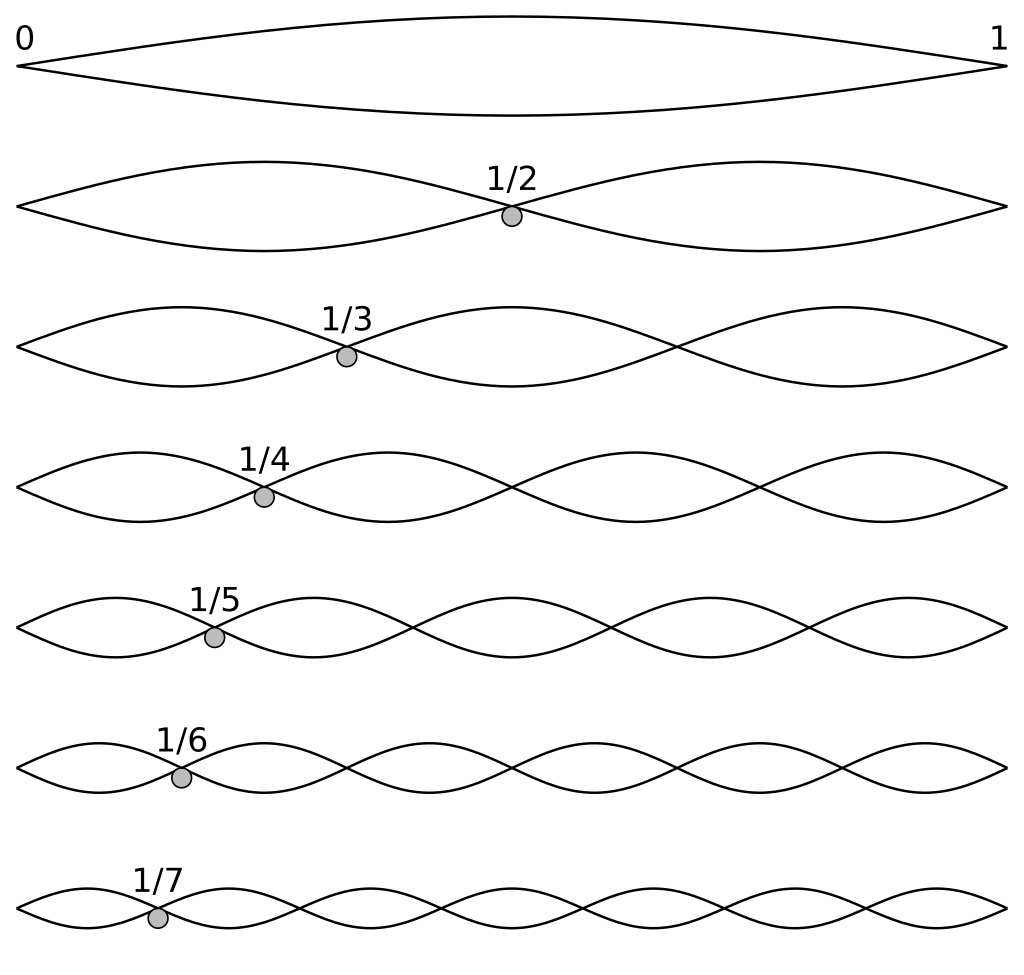
Pythagoras’ thoughts were based on the belief that the planets and stars moved in perfectly ordered, concentric spheres around the Earth, each emitting a unique frequency or vibration, creating a kind of ‘cosmic music’ that, while inaudible to human ears, influenced the harmony of existence.
“There is geometry in the humming of the strings and there is music in the spacing of the spheres“. – Pythagoras
The idea continued to appeal to great thinkers, influencing scholars of many kinds. In “Mysterium Cosmographycum and Harmonices Mundi” German astronomer, mathematician, astrologer and natural philosopher Johannes Kepler further developed Pythagoras’ ideas and suggested that the planets of the solar system are spaced according to specific geometries. For instance, the maximum angular speed of the Earth as measured from the Sun varies by a semitone (a ratio of 16:15), from ‘mi’ to ‘fa’, between aphelion and perihelion. Venus only varies by a tiny 25:24 interval (called a diesis in musical terms).
It was not until 1638 when Italian astronomer, physicist and engineer Galileo di Vincenzo Bonaiuti de’ Galilei came with an explanation of the relation of pitch to frequency, consonance, and dissonance. The mathematical theory of sound propagation began with Isaac Newton, the English polymath (active as a mathematician, physicist, astronomer, alchemist, theologian, and author), whose Principia (1686) included a mechanical interpretation of sound as being “pressure” pulses transmitted through neighboring fluid particles.
Several centuries later the first experiments to determine the exact frequencies of sounds took place during the “Acoustic Era” (approx. 1870-1925), when scientists started measuring sound frequency, using electric measuring and recording equipment.
Nikola Tesla about the ‘Music of the Spheres’, it’s relationship to Light.
“The matter is created from the original and eternal energy that we know as light. She shone and the stars, the planets, the man and everything on Earth and in the Universe appeared. The matter is an expression of infinite forms of light because the energy is older than it.
There are four laws of Creation. The first is that the mind can not conceive or mathematically measure the source of the whole bewildering and dark plot, in that plot fits the whole Universe. The second law resides in expansive darkness, which is the true nature of light, of the inexplicable, and is transformed into light. The third law is the need for light to become a matter of light. The fourth law is: there is no beginning or end; The three previous laws always take place and Creation is eternal.
I am part of a light and it is music.
About Pythagoras and mathematics, a scientist can not and should not infringe on these two. Numbers and equations are signs that mark the music of the spheres.
These sounds are messages directed to the mind about which life has a meaning, that the Universe exists in perfect harmony, and its beauty is the cause and effect of Creation.
This music is the eternal cycle of stellar skies. The smallest star has completed the composition and is also part of the celestial symphony. The heartbeats of man are part of the symphony of the Earth. Newton learned that the secret is in geometric arrangement and the movement of the celestial bodies. He acknowledged that the supreme law of harmony exists in the Universe. ”
Source: “Everything Is Light” – The Incredible Interview With Nikola Tesla In 1899
Fellow blogger Joe Dubs created for his article about Musical Geometry a nice visualization of the planetary relationships (distances according to NASA) as written about in an article of Keplerstern Verlag. A couple of these planetary relationships represent musical ratios. Read this article to learn more about the Semi-Minor Axes Geometry …
Left to right: Mercury, Venus, Earth, Mars, Jupiter, Saturn, Uranus, Neptune, Pluto.

In the image above you see the following musical ratios: 2:1 = Octave, 3:2 = Perfect Fifths and 4:1 = 15th (or 2 Octaves). The other ratios (8:3, 25:1 and 25:4) aren’t common intervals in musical tuning, but for those who enjoy microtonal music those macrocosmic ratios might be worth experimenting with.
Another article by Joe Dubs with nice visualizations on this subject is his article about the orbital patterns of the planets in our solar system reveals other musical ratios such as the tonic (1:1) and perfect fourths (4:3). “The Music of the Spheres – Musica Universalis” (Joe Dubs) might be a nice read for you as well …
It is interesting to note that the most important interval in music, the 5th (the interval Pythagoras based his musical tuning system on), represents the relationship between Earth and Mars. Astrology wasn’t something Pythagoreans were much interested in though, unlike Astronomy … but that aside:
In astrology, Mars is the planet of determination, ambition and competition, energy, action, desire, passion, aggression, anger. Mars, the God of War, is the ruler of Aries. It is the survival instinct, and can be thought of as the “leftover” animal nature of man. Our sexual desires come under the rule of Mars. Mars’s energy can be constructive or destructive. It takes nearly two years for Mars to complete its orbit through the zodiac.
“Sounds are the echo of the “Harmony of the Spheres” which man took into himself when he came down from the divine-spiritual world into the physical world.“ – Rudolf Steiner
Many great thinkers such asPlato, Nicomachus of Gerasa, Galileo, Martin Mersenne and Athanasius Kirchner continued developing what Pythagoras started.
A different more literal, creative, modern scientific approach to “Music of the Spheres” is the work “Wheel of Stars” by Jim Bumgardner, where Bumgardner relates star position, parallax, magnitude, and color information to sound pitch.
In the more recent history Music of the Spheres has inspired various (contemporary) composers and artists such as: Rued Langaard (“Music of the Spheres“), Mike Oldfield (“Music of the Spheres“), Björk (“Cosmogony“) and others …


Sources:
- “Everything Is Light” – The Incredible Interview With Nikola Tesla In 1899
- http://joedubs.com/musical-geometry/
- Various Wikipedia pages
