
Ego … and what to do with it?
What is Ego actually? In general we may connect rather negative selfish vices such as the seven deadly sins (also known as the capital vices or cardinal sins) with Ego.
These seven capital vices are:
1. gluttony
2. lust
3. greed
4. sadness/sorrow/despair
5. wrath
6. boasting/vanity
7. pride
Sometimes an 8th is added: sloth. So, obviously one might think the Ego is something bad, right? The term ego has variouis interpretations, depending on whom you would have asked. If you would ask for example psychiatrists Sigmund Freud and Carl Jung, or philosopher Rudolf Steiner, you would get different viewpoints.
Here’s Sigmund Freud‘s viewpoint:
The id, ego, and super-ego are a set of three concepts in psychoanalytic theory describing distinct, interacting agents in the psychic apparatus (defined in Sigmund Freud‘s structural model of the psyche). The three agents are theoretical constructs that describe the activities and interactions of the mental life of a person.
The Id is the instinctual component of personality that is present at birth, and is the source of bodily needs and wants, emotional impulses and desires, especially aggression and the libido (sex drive).
The ego acts according to the reality principle; i.e., it seeks to please the id’s drive in realistic ways that, in the long term, bring benefit, rather than grief.
The super-ego reflects the internalization of cultural rules, mainly taught by parents applying their guidance and influence.
Wikipedia
Let’s have a look at Carl Jung:
Jung considered that from birth every individual has an original sense of wholeness – of the Self – but that with development a separate ego-consciousness crystallizes out of the original feeling of unity. This process of ego-differentiation provides the task of the first half of one’s life-course, though Jungians also saw psychic health as depending on a periodic return to the sense of Self, something facilitated by the use of myths, initiation ceremonies, and rites of passage.
Wikipedia
A beautiful viewpoint, sharing – as I see it – the idea that one needs to understand and ‘work’ the ego in order to find wholeness of the Self again. The use of myths, initiation, ceremonies and rites of passage resonate to me with the self-improvement philosophies such as: Buddhism (“The Ritual of Renunciation” includes: Pabbajja = initiation, Upasampada = ceremonies), Advaita Vedanta Hinduism (“The Ego’s Formal Funeral includes”: Diksha = spiritual initiation, Sannyasa = the ultimate Rite of Passage), Stoicism (The Sage, Entering the Stoa, Voluntary Hardship), and Daoism (Lu = Register transmission, Jiao = sacrificial rituals of cosmic renewal, Neidan = Rites of passage to dissolve the rigid, mortal self), as well as Mystery School traditions such as Rosicrucianism and Freemasonry.
The Distinction Between Selfishness and Egocentrism
teachhq.com
Selfishness stems from a conscious preference for one’s needs over those of others. In contrast, egocentrism in early childhood is a natural cognitive phase where children are yet to realise that others might have different viewpoints or emotions from their own.
The viewpoint shared on teachhq is interesting. It shares the idea that egocentrism is a natural phase in every child’s life. It is though important we ‘grow out’ of that phase, leave it behind, and that’s where parenting/education comes in. This aligns with the views shared by Jung. It is thus a matter of managing or training the ego, as I will come to later in this article.
One of Rudolf Steiner’s most frequently cited statements about the ego appears in his book Theosophy:
“The little word ‘I’ is a name differing from all other names. Anyone who reflects in a suitable manner on the nature of this name has access to an approach to the understanding of human nature in its deeper sense.”
According to Steiner, the ego (often called the “I” or “Ego-being”) is the uniquely human spiritual core that gives a person self-consciousness, individuality, and the capacity for freedom. Unlike the body, life forces, emotions, or ordinary thoughts — which humans share to varying degrees with nature and other beings — the ego is what allows a person to say “I” to themselves and gradually become a self-determining moral individual. Steiner saw human development as a process in which the ego transforms and ennobles the lower aspects of the person (physical, emotional, and mental life), increasingly expressing spiritual qualities such as truth, love, and ethical insight. In his view, the ego is not merely a psychological construct but a real spiritual individuality that evolves through successive lifetimes and serves as the central agent of human growth and conscious participation in spiritual reality.
A very different viewpoint on what the ego (or Ego-Being) is than the viewpoints of Freud and Jung. What stands out here again, is that transformation is required (work needs to be done) to become a better person, not better than someone else, but a better version of oneself.
So, we’re back at the initial question: “Ego … and what to do with it?“
Freud might have suggested that ego would likely be a defence against insecurity (compensation or reaction formation), Jung though might have seen a ego as someone being trapped in the persona (a state of inflation and deep imbalance) and Steiner might have said the spiritual “I” has failed to uplift their soul (being stuck in the lower nature / lower self).
While Freud saw the ego as a practical shield managing daily survival and Jung saw it as a narrow island of awareness that must connect with a deeper subconscious, Steiner viewed the ego as an immortal, divine spark.
For Freud, the ego is a mental referee balancing dark urges and social rules. Jung expanded on this, arguing the ego is just a small fragment of our identity that must eventually lower its guard to achieve psychological wholeness. Steiner took the concept out of traditional psychology entirely, defining the ego as a literal spiritual being that inhabits the human body across multiple lifetimes to develop free will and moral consciousness.
It is good to be aware that there might be a reason for someone’s “big ego” that might be another than pure selfishness.
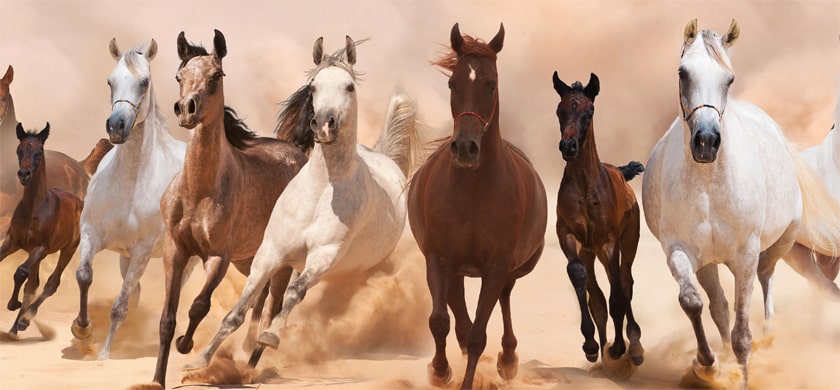
To visualize what was shared by Freud, I like to compare that trinity mentioned above with a horse … When a horse is born it is still wild and untamed. It acts on instinct and responds to desires. This instinct / those desires are what is described above as id. If a horse stays untamed it might be exiting to observe in the wild, but it will be unpredictable and might bite or kick you when you come near. If you do manage to mount and stay on it, you will no longer be “in control” where you will go, you will be slave to the will of the wild horse.
If you wish to make use of a wild horse, you need to tame it. What methods you deem fit for it’s training program is defined by the super-ego (representing morals, norms, values through parenting, education, culture). You could see taming the horse as teaching the horse how it should react to it’s id (wild instincts). Once the taming is done, horse and rider (your conscious self) need to learn to work together. As rider you use the reins for that. You could compare the Ego – that has to mediate (steer) between id (instincts) and super-ego (training/education) – with the rains. I think – when looking at the Ego like this – we can conclude that Ego is neither good nor bad. What I am trying to say with the comparison is that we as rider should tame the horse and learn to master the Ego. If we fail to tame the horse and master the Ego with rains, then we are not in control, we are not the master of the horse, but are roles reversed and the will of the wild horse will enslave us.
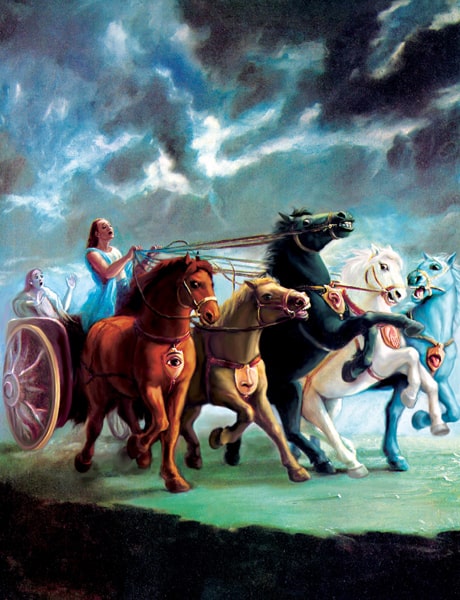
A (more spiritual) line of thought – somewhat related to this – is how in the Bhagavad Gita the relationship between the Body, Mind, Self and the Senses is described:
“The Body is the chariot. The five Senses are the chariot horses. The Mind is the rains, the Intelligence is the chariot driver, the Self is the chariot’s passenger. Everything perceived by the Senses (horses) are the chariot’s path.“
In this line of thought the horses (senses) present the id and the Mind presents the Ego. Also there the message seems to be that one should use the rains to control the horses and steer the chariot.
Greed, vanity, jealousy, pride, power craziness, et cetera are the result of the lack of “taming” the id (and Senses) and/or a lack of mastering (using one’s Mind to control) the Ego, the Ego that then gives into / pleases the id in it’s desires. I think this is where the negative image of the Ego comes from. It is important to keep in mind that the Ego is not sharply separated from the id, they overlap.
Taming your desires and mastering one self requires real effort, can be a time consuming process and isn’t always easy. It is though a choice.
Seven behaviors that indicate a large ego (but can also have other causes):
1. Inability to admit being wrong
2. Difficulty accepting criticism
3. Struggling to apologize
4. Needing to be right or win
5. Seeking status and validation
6. Feeling threatened by others’ success
7. Taking disagreement personally
One should be careful with assuming someone has a “big ego”. These signs could also be exemplary for, or the result of compensating or masking other issues. By example:
1. Perfectionism, fear of punishment, shame, rigid thinking, strong identification with expertise.
2. Rejection sensitivity, anxiety, low self-esteem, traumatic criticism in childhood, perfectionism.
3. Difficulty expressing vulnerability, pride, shame, family norms where apologizing was discouraged.
4. Competitive upbringing, professional conditioning, insecurity, fear of failure.
5. Deep insecurity, unmet emotional needs, loneliness, lack of self-worth.
6. Low self-confidence, scarcity mindset, fear of being left behind.
7. Emotional sensitivity, anxiety, past experiences of rejection, poor emotional boundaries.
Seven behaviours commonly attributed to ego, but often explained by other factors:
1. Interrupting others
2. Dominating conversations
3. Inability to say “I don’t know.”
4. Taking everything personal
5. Taking excessive credit
6. Entitlement or expecting special treatment
7. Confusing attention with respect
These signs could also be exemplary for, or the result of compensating or masking other issues. By example:
1. Excitement, impatience, poor conversational skills. ADHD or ASS.
2. Social anxiety (talking to avoid silence), loneliness, lack of awareness, enthusiasm. ADHD.
3. Fear of looking incompetent, professional pressure, perfectionism.
4. Low self-esteem, anxiety, rejection sensitivity, past emotional wounds.
5. Insecurity, poor self-awareness, workplace survival habits.
6. Learned family norms, privileged upbringing, immaturity, lack of perspective.
7. Inexperience, unmet need for validation, loneliness, insecurity.
Thus, be careful before you assume something about others, and even more with judging others, specially if you don’t really know someone. Careful with labels like “big ego”, egoist and egocentric emphasize the presumption!
