

FREEMASONRY AND PROCLAIMED PREDECESSORS
In various books, movies and online sources, claims have been made about the origin of Freemasonry and presumed predecessors, such as the Knight Templar and Rosicrucian’s. Let’s shed some light on those claims …
Proclaimed Predecessors: Knights Templar | Rosicrucians | Druses
A PERSONAL NOTE
I have always been fascinated by Knighthood, Knightly Orders, The Crusades and the Knights Templar in particular, reading historical novels, history books, watching documentaries and movies since childhood.
Still a young boy, I was thrilled to learn the meaning of my name; Roelant [ roo-lahnt ] is the Dutch version of the French name Roland (pronounced in English as: roh-luh-nd or rəʊlənd ), from the Old Frankish Hrōþiland (Hroshfinand), in Medieval Latin: Hruodlandus. Hrodland meaning: hrod = “fame” or “honour”, and ‘land’ (a variation on ‘nand’) = “daring”. One of the famous Roland’s in history was a Knight, Count Roland, nephew and Paladin of Charlemagne, with his famous sword ‘Durendal‘. I found ‘La Chanson de Roland‘ particularly impressive and dreamt about being Knighted, owning a famous sword and being involved in great acts of Bravery.
While growing up I thought I was born in ‘the wrong time’ to ever become a Knight and wield a sword. It wasn’t until I was initiated into Freemasonry that I learned that ‘Knights’ (be it only by title) still existed, and wielding a sword (be it ceremonially) still happens during rituals and ceremonies. In various Masonic Rites a title ‘Knight” comes with a particular degree.
FREEMASONRY AND THE KNIGHTS TEMPLAR
“The connection of the Knights Templar with the Freemasons may much more plausibly be traced than that of the Knights of Malta. Yet unfortunately, the sources from which information is to be derived are for the most part traditionary; authentic dates and documents are wanting.“
– John R. Bennett
The earliest documented proclaimed link between Freemasonry and the Crusades is the 1737 oration of the Chevalier Ramsay. He claimed, without supporting historical evidence, that European Freemasonry came about from an interaction between ‘crusader Masons‘ and the Knights Hospitaller. The Knights Hospitaller (nowadays Sovereign Military Order of Malta) and the Knights Templar were not on good terms with one another though, and when the Knights Templar were dissolved through papal bulls and prosecution, most of their confiscated wealth was handed over to the Knights Hospitaller.
For this article I will set the Knights Hospitaller aside and focus at the Knights Templar.
Its a fascinating topic, the Knights Templar and, much like Freemasonry, veiled in Mystery. Naturally without proper documentation and evidence there is more then enough room for speculation, intriguing theories or even conspiracies. I will share one of these with you:
The Knights Templar insisted, after their establishment in 1118, on having their headquarters on the Temple Mount in Jerusalem. When Jerusalem was taken by the Saracens the Templars were forced out and moved to France. Some theories suggest that, when King Philp IV of France and Pope Clement conspired against the Knights Templar in 1307, several Templars escaped their arrest, prosecution and execution.
Mainstream historians though claim the Knights Templar Order was fully dismembered and ceased to exist. Some Masons instead propounded that after their escape the Knights Templar found refuge by sympathetic Masons and Robert the Bruce, King of Scotland. Albert C. Mackey M.D. shared in ‘Encyclopedia of Freemasonry and its Kindred Sciences‘ (p. 342 and p. 946-947) a few stories such.
At the time of the disappearance of the Templars in and around 1307, those Masonry Guilds likely resumed doing their business as usual. Freemasonry emerged several hundred years later though, that is, if we may believe various documents from that period. The oldest and most important Masonic manuscripts that suggest the existence of Freemasonry from around that time are: The Avignon Decree (1326), The Regius Manuscript (1390) and The Cooke Manuscript (1450).
What interpretation of history is true? Did the Knights Templar ceased to exist or is the Masonic account right?
Supposition: What if the Templars never left their refuge, merged the remnants of their Order with local (Masonic) Guilds, and with it gave birth to Freemasonry?
– Both Masons and Knights Templar were influenced by esoteric and early Christian believes.
– Both were accustomed with initiations, secrecy, brotherhood, et cetera.
– Both considered Solomon’s Temple a place of great importance. The Templars had chosen the Temple Mount in Jerusalem as the site for their sacred headquarters: it was believed that Solomon’s Temple had stood there. And Masons had actually build Solomon’s Temple, that story was of equally great importance. It should not come as a big surprise that the build of Solomon’s Temple played an important role in Masonic rituals from the 1720’s onwards, when the Master Mason Degree was presumably ‘invented’ and references to the build of Solomon’s Temple were added in the rituals.
Could these Freemasons have continued where the Knights Templar Order ended?
Or is it all Masonic Mythology and are the Knights Templar references in Freemasonry nothing but allegory and symbolism, veiled in mystery, much like allegories related to Solomon’s Temple and it’s Masonic symbolism? After all, Freemasons, unlike their Operative Mason predecessors, don’t chisel in stone in their mundane life either.
WHAT DO WE ACTUALLY KNOW FOR FACT?
Despite Freemasonry’s general disclaimer that no one regular Masonic organization actually claimed a direct heritage to the medieval Knights Templar, certain degrees and orders are obviously patterned after the medieval Order. These are best described as “commemorative orders” or degrees. Nevertheless, in spite of the fraternity’s official disclaimers, some Masons, non-Masons and even anti-Masons insist that certain Masonic rites or degrees originally had direct Templar influence.
The Knights Templar, full name ‘The United Religious, Military and Masonic Orders of the Temple and of St John of Jerusalem, Palestine, Rhodes and Malta‘, is a fraternal order affiliated with Freemasonry. Like the Masonic Red Cross of Constantine being inspired by the Sacred Military Constantinian Order of Saint George and the Order of Malta being inspired by the Sovereign Military Order of Malta, the Masonic order of Knights Templar derives its name from the medieval Catholic military order Knights Templar. However, it does not claim any direct lineal descent from the original Templar order.
Depending upon the geographical jurisdiction, the Knights Templar exist either as part of the York Rite or as an independent organization. Though the York Rite and the independent versions share many similarities there are key differences.
Membership of this order is open for (Master) Freemasons who profess the Christian faith and are willing to make an obligation on the Tri-Unity, and are Royal Arch Masons.
Personal note: a Knight Templar I will never be. As Dualist Pantheist I don’t profess the Christian faith and interpret the ‘Tri-Unity’ differently.
FREEMASONRY AND THE ROSICRUCIANS
From: “ROSICRUCIAN AND MASONIC ORIGINS“
For this article I have selected a few “snippets” that – to me – felt as most essential. I suggest you read the complete work!
“The secret doctrine that flows through Freemasonic symbols (and to whose perpetuation the invisible Masonic body is consecrated) has its source in three ancient and exalted orders. The first is the Dionysiac artificers, the second the Roman collegia, and the third the Arabian Rosicrucians.“
“The Dionysians were the master builders of the ancient world. Hiram, King of Tyre, was the patron of the Dionysians. The tools of the builders’ craft were first employed by the Dionysians as symbols under which to conceal the mysteries of the soul and the secrets of human regeneration. The Dionysians also first likened man to a rough ashlar which, trued into a finished block through the instrument of reason, could be fitted into the structure of that living and eternal Temple built without the sound of hammer, the voice of workmen or any tool of contention.“
“The Roman collegia was a branch of the Dionysiacs and to it belonged those initiated artisans who fashioned the impressive monuments whose ruins still lend their immortal glory to the Eternal City.“
“The Mysteries of Egypt and Persia that had found a haven in the Arabian desert reached Europe by way of the Knights Templars and the Rosicrucians. The Temple of the Rose Cross at Damascus had preserved the secret philosophy of Sharon’s Rose; the Druses of the Lebanon still retain the mysticism of ancient Syria; and the dervishes, as they lean on their carved and crotched sticks, still meditate upon the secret instruction perpetuated from the days of the four Caliphs.“
“The modern Masonic order can be traced back to a period in European history famous for its intrigue both political and sociological. The forerunner of modern thought was beginning to make its appearance and all Europe was passing through the throes of internal dissension and reconstruction.“
“So with the Masonic Mysteries of today. Each Mason has at hand those lofty
principles of universal order upon whose certainties the faiths of mankind have ever been established. Each Mason has at hand those lofty principles of universal order upon pregnant with life and hope to those millions who wander in the darkness of unenlightenment. From the unprobed depths of Arabian Rosicrucianism also issued the illustrious Comte de St.-Germain, over whose Masonic activities to this day hangs the veil of impenetrable mystery. The exalted body of initiates whom he represented, as well as the mission he came to accomplish, have both been concealed from the members of the Craft at large and are apparent only to those few discerning Masons who sense the supernal philosophic destiny of their Fraternity.“
“Long before the establishment of Freemasonry as a fraternity, a group of mystics founded in Europe what was called the “Society of Unknown Philosophers.” Prominent among the profound thinkers who formed the membership of this society were the alchemists, who were engaged in transmuting the political and religious “base metal” of Europe into ethical and spiritual “gold”; the Kabbalists who, as investigators of the superior orders of Nature, sought to discover a stable foundation for human government; and lastly the astrologers who, from a study of the procession of the heavenly bodies, hoped to find therein the rational archetype for all mundane procedure.“
“Several initiated Rosicrucians were brought from the mainland to England, where they remained for a considerable time designing the symbolism of Freemasonry and incorporating into the rituals of the order the same divine principles and philosophy that had formed the inner doctrine of all great secret societies from the time of the Eleusinia in Greece. The adepts brought over from the Continent to sit in council with the English philosophers were initiates of the Arabian rites and thus through them the Mysteries were ultimately returned to Christendom.“
“Such, in brief, is the story to be pieced together from the fragmentary bits of evidence available. The whole structure of Freemasonry is founded upon the activities of this secret society of Central European adepts; whom the studious Mason will find to be the definite “link” between the modern Craft and the Ancient Wisdom. Even the casual observer must realize that the true wealth of Freemasonry lies in its mysticism.“
– Manly P. Hall
From Lectures on Ancient Philosophy – An Introduction to the Study and Application of Rational Procedure: The Hall Publishing Company, Los Angeles, First Edition 1929, pp 397-417
“The connection between Freemasonry and the Rosicrucians is a bit hazy at best. While they both promote similar tenets and philosophies, neither have an exact common denominator. As noted, there is no direct connection between the two. However, some claim that Freemasonry came from Rosicrucianism.“
“Some of the clear differences would be that the Rosicrucians were religious men whose doctrines were of spirits, of the elements, of numbers and heavenly bodies, and their influence on men. The Freemasons were founded by builders, whose symbols are applied in architecture and is usually described as a peculiar system of morality, veiled in allegory, and illustrated by symbols.“
“In the early 18th century, the scientific ideals of Rosicrucianism began to make their way into the progressive social contracts that formed the basis of modern Freemasonry. From that point forward, Rosicrucianism and Freemasonry worked hand in hand to promote freethinking, social progressivism, and scientific discovery.“
“Rosicrucian Freemasons do exist though, its members being Master Masons.”
– RWB Robert H. Johnson
‘Rosicrucian Freemasons’ are members (Fraters) of several Masonic Rosicrucian Orders, such as SRIA, SRIS, SRICF, The Rosicrucian Society, et cetera, all distinguished fraternities rooted in esoteric wisdom, with a mission to explore the mysteries of ancient Rosicrucian philosophy. You have to be Master Mason (Blue Lodge Freemasonry) before you can apply for membership.
“The intertwining of Rosicrucianism and Freemasonry traces back to the dawn of time. The earliest documented evidence of this connection is found in Henry Adamson’s ‘The Muses Threnodie,’ published in Edinburgh in 1638.
Many Masonic historians propose that modern Speculative Freemasonry is deeply indebted to the Rosicrucian movement.“
– SRIA
From: “ROSICRUCIANS, THEIR HISTORY AND AIMS
With reference to the alleged connection between Rosicrucianism & Freemasonry.” Ars Quatuor Coronatorum vol. 7′ (Research Lodge Quatuor Coronati, London
“The SRIA was constituted by the late Robert Wentworth Little, well known as a prominent mason, and Secretary to the Royal Masonic Institute for Girls [ … ] but the right to the name and the inspiration which set it going was supplied by the late Kenneth R. H. Mackenzie, who, when in Germany in early life, became acquainted with descendants of the old Rosicrucian Fraternity; they admitted him to some lower grades, permitted him, as an experiment, to bring about the formation of an almost exotic society among Freemasons, and to use the midiæval German name. So much for the connection in modern times between Rosicrucians and Freemasons.“
“It is, I believe, not so seriously denied by any one that Freemasonry before 1800 was a society avowedly Christian, as well as being composed of professing Christians, so that on this ground, for one, there is some reason for the suggestion that early Freemasons were related to the Rosicrucians. The crux of the whole matter before us is that the early relation between the Societies, if any; and now there dawns upon you, possibly, the utter impossibility of ever demonstrating conclusively either the relation, or an entire distinction between Freemasonry and Rosicrucianism. The difficulties are obvious and irremovable It is hard enough to show evidence of relation between institutions which existed in a distant past.“
“Masonry a hundred years ago was Christian, in a sense at any rate, and Rosicrucian doctrine is Christian upon the face of it. This is one bond of allience, and there are others. The great principles of Freemasonry are stated to be Brotherly Love, Relief and Truth; now these are merely names for purposes which are found in the oldest Rosy Cross books to be their aims and objects: see their ‘Fama et Confessio, 1615‘.“
“I am content with Bro Gould’s dictum at p. 60 of vol. II of his History of Freemasonry: – He writes, “it is clear that the Masonic body had its origin in the trades unions of midiæval operatives,”- just so, but that statement throws no light on the origin of our Masonic Ritual, in which the terms of operative art are almost restricted to the Explanantion of the Working Tools; while other symbolism, entirely apart from the building arts, is so prominent. This other symbolism is exactly of the nature that our Rosicrucians were capable of supplying, and my contention is that they did supply it.“
“In conclusion then, Bretheren, I consider that our existant Speculative Masonry was derived from two parents, and was gradnally perfected from materials drawn from these two sources; from the Trade Guilds it obtained it’s organization and first nominal chiefs; its historic traditions and maronry being co-eval with the erection of stately edifices, and the general craft symbolism of its ritual; while from the Rosicucians, whose philosophy at that time (1650-1700) been made more popular and less esoteric, it derived all the moral philosophy, its semi-Christian ideals, and its halo of mystic secrecy. Further upon the necessarily predominant ideal of the trade guild, mutual support and protection, was grafted from the same Rosicrucian source the newly formulated but old existing ideals of universal benevolence and the search after those real truths which underlie our humanity, and have been so grievously hidden beneath our forms of religion and civilization.”
– Dr. W. Wynn Westcott, W.M.
To make things more complicated, the Ancient and Accepted Scottish Rite (ASSR), includes the 18th degree called Knight of the Rose Croix. This degree has no connected with SRIA, SRIS or SRICF, nor with other Rosicrucian Orders.
Non-Masonic Rosicrucian Orders such as AMORC (Ancient Mystical Order of the Rosy Cross or Ancient / Mystical Order Rosæ Crucis) are not related to the Masonic Rosicrucian Orders or AASR mentioned above.
THE DRUSES OF SYRIA AND THEIR RELATION TO FREEMASONRY
from: Ars Quatuor Coronatorum vol. 3 – By Bro. Rev. Haskett Smith
“It is not my purpose in the present paper to enter into any detailed history of the Druses, interesting and instructive as the subject would be. [ … ] for my object now is to prove a couple of propositions, both of which bear intimately upon the history of the Craft of Freemasonry.“
(I) Solomon’s Temple Builders
“They had no relations or business or friendships with other races; and, with one solidary exception in their history, nothing ever occurred to bring their names into notice. The solitary exception was occasioned by the building of Solomon’s Temple (a very important figure and event in the allegories of Freemasonry). Hiram I, King of Tyre, sovereign of all Phoenicia, maritime and mountainous, proffered his services to his royal neighbour, and, in de prosecution of his friendly assistance, he commissioned that portion of his subjects who inhabited the rural districts on the Lebanon slopes, to hew down the Cedar trees, to fashion the timbers, to quarry the stones, and to perform all the other necessary labours in connection with the undertaking upon which he had embarked. Thus, when we read, either in the pages of the Bible or in the history of the Craft, of the subjects of Hiram, King of Tyre, who assisted in the erection of Solomon’s Temple, we must remember that these were principally those Phoenicians who belonged to the agricultural and domestic class. It is true that their Brethren of the seaboard had also their share in the work, for it was they who were responsible for the sage transfer of all the materials from the Phoenician ports to Joppa, and from thence to their destination at Jerusalem. But the Craftsmen and Masons themselves were mountaineering Phoenicians, inhabitants of those very districts where, many centuries afterwards, Hamzé preached his new religion and founded the sacred worship of Drusedom.“
“It had long been understood that the Phoenician race and nationality has become extinct, so far as its individuality of existence is concerned. That is to say, those seafaring merchants and traders who inhabited the maritime districts ruled over by those Kings of Tyre and Sidon have indeed lost their distinctive nationality.“
“There is a universal tendency amongst all Eastern tribes to maintain unchanged for centuries upon centuries their habits, customs, race distinctions, and places of abode. Such would especially be the case with an exclusive, retiring, and pastoral peasantry, such as the mountaineering subjects of the Kings of Phoenicia.“
“When Hamzé came amongst this people he found them practically without a religion. Their rigid exclusiveness of nature had forbidden them to embrace any religion; and one of the chief recommendations of Hamzé‘s faith was that is supplied them with a religion which they could have entirely to themselves. It is, however, a matter of the most significant note that, though Hamzé could not detect amongst this people any traces of a sacred religion, in the strictest sense of the word, beyond their vague acceptance of the idea of One God, he nevertheless found an existence amongst them of certain secret and mystic rites.“
“To these he alludes particularly in his writings. He speaks of their signs and passwords, of their different degrees of initiation, and of their assemblies within closed doors. These ancient traditional rites and mysteries he appears to have incorporated with his new religion, and some of their phrases, ideas and sentiments he employs and makes use of as if they were his own. I have thus been enabled to trace without, as it seems to me, any missing link, the unbroken continuity between the pastoral subjects of Hiram I, King of Tyre, and the Druses of the present day.“
“We come now to another remarkable point. The Druses invariably assert with confidence that they were the builders of Solomon’s Temple. The Druses know very little about the Bible or the history of the ancient Israelites [ … ] But there is one name of ancient Old Testament story that stands out conspicuous in the traditions of the Druses. That one name is Solomon. It is in him that all their legends and wonderful stories concentre; [ … ] he occupies the most sacred place in their sanctology.“
(II) An intimate connection of the Druses with the Ancient Craft of Freemasonry
“It is well known to every Brother of the Craft that a threefold condition[3] is laid down for the eligibility of a candidate to initiation into the mysteries if Freemasonry. [ … ] there are enumerated, in like manner, three conditions for the admission of a candidate into the Druse religion.”
[3] To be of full age, free-born and of good report.
Sacred book of the Druses: “He that believeth in the truths which have been set forth in this book is eligible for admission to the ranks[4], and to take his place in the secret assemblies[5], provided that he be of full age, free from servitude, and sound of mind and body.“
[4] i.e. degrees if initiation
[5] i.e. the lodges
Those conditions are surprisingly similarly.
“I have already referred indirectly to the different degrees of initiation which have been customary amongst the Druses from time immemorial. I may here state that they are at least three in number.
There are the first those who are called ‘Jâhels’ or ‘unlearned’. These are Druses who have merely passed through the preliminary stage of initiation in their childhood, which consist of a ceremony [ … ] and other mystic observances […]. The first class of Druse initiates, then, of which J have spoken, the Entered Apprentices, as it were, are admitted only to the general assemblies of the Church. They are allowed to wear no distinctive garment, and they can scarcely be discriminated by a casual observer from the ordinary Arab or Syrian of the country.
The second class are called ‘Akkals’ or ‘learned’ and are admitted by some mystic secret rite, the nature of which I have been unable to learn. These correspond, so to speak, to the Fellow-Craft of Freemasonry, and they form perhaps the majority of adult Druses.
The third class is that of which the ‘Khateebs’ or ‘priests’, belong , and they correspond to the Master-Mason. Their initiation is, I believe, of very solemn and mystic character; and inasmuch as they occupy a higher and more sacred position than the others, they have in their turn, certain further prescriptions laid upon them.“
“In addition to these, […] just as the three degrees constitute the general orders of Freemasonry, there are, I believe in some villages of the Lebanon and Haurân, certain Druses of a higher and more mystic degreem who are known by their Brethren as Prophets and Seers; such as for example, as the ‘Star-Divner’, as their chief astrologer is called.“
“We come now to tokens, passwords, and signs. And here let me acknowledge at once that, whatever may be the passwords in vogue among the Druses, they are certainly not words familiar to Freemasons.“
“Every Druse village and settlement has its Khalweh, or place of sacred meeting. In common language it might be called the Druse Church, but I prefer to entitle it, more accurately, the ‘Lodge’. During the time of meeting a man is always to be seen stationed on the outside of the Khalweb, and his business is to prevent the approach of any outsider near the place. He is, in fact, the Tyler of the Druse Lodge, whose duty it is to keep off all cowans and intruders from the mysteries of the Craft.“
“Though excluded perforee from admission to the Kahlweh during the performance of the Druse mysterious functions, I have, however, inspected the interor of these Khalwehs in many different places and villages at a time when not rites are going on. I have noticed that they are always build with a striet regard to due orientation – that is to say they invariably face north, south, east, and west. They are plain oblong building, nearly square. There are two entrance doors, both in the western wall. […] A thiek, impenetrable curtain stretches from west to east, screening off a small portion of the southern end, and behind this curtain women congregate.“
“The only conspicuous objects which strike the visitor, on entering the Khalweb, are certain symbols and figures, inscribed on the eastern wall. They are as follows: a text in Arabic, the English translation of which may be rendered: “Oh, Thou secret source of good, keep us from that which we most must fear.” Tje Kahteeb of my village explained this passage to me. He told me that hte object which de Druse most must fear is a treacherous revelation of the mysteries of his faith: and that this verse was graven upon the wall to remind every Druse, on his entry into the Khalweh, of his binding obligation to preserve inviolate secrecy.“
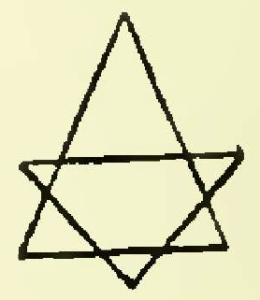
“Above this inscription is a rough emblem apparently intended for a double triangle. But I have noticed that the upper angle of the top triangle is always very acute, whilst the bottom angle of the lower triangle is invariably almost square. Take away the two horizontal lines, which may have erept in in the course of years, and we have the Masonic emblem of the Square and Compasses.“
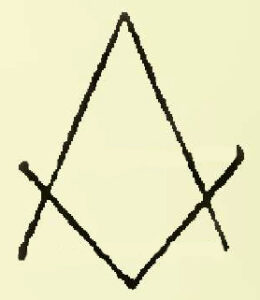
“Above this device is an oval figure, undoubtedly intended to symbolize the Eye of God. Here then, again, we have distinct evidence of a close analogy between the emblematical designs of the Druse religion and those of the Craft of Freemasonry.“
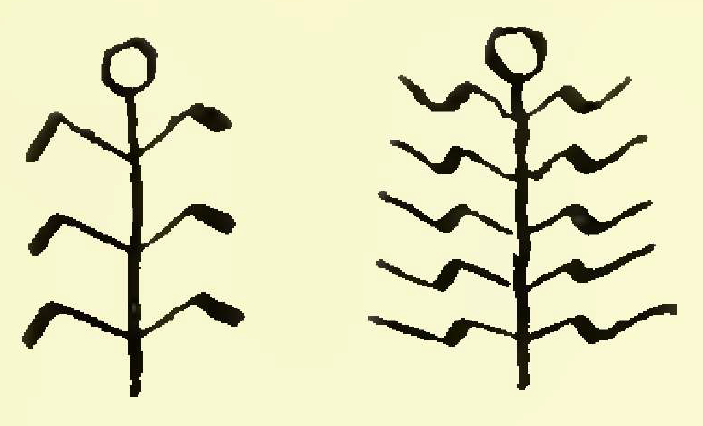
“Besides these are certain strange and forms which the Druse woman and girls called “Brides”, because, I presume, of their fancied resemblance to a human figure. They are, indeed, not so very unlike the first efforts of a child to draw the body of a man. But the peculiarity is that there are always an uneven number of arms and legs (or whatever they are meant to be) on each side.“
“Knowing the significance of the numbers 3 and 5 in Masonic symbolism, it has also seemed to me that here one has another evidence of the mystic relation between the two systems.“
“In connection with numbers, I may here point out that in the Druse esoteric code the number 7 occupies a very important place. Thus, according to them, the world has seen 7 great lawgivers, 7 special high priests, and 7 major prophets, each inspired by the 7 original spirits. The moral law of Hamzé is summend up under 7 heads, of the 3 principal of which I shall presently speak. But the most interesting, perhaps, of these combination of 7s, so fa as regards the relation of Drusedom to Freemasonry, is the belief which they hold as to the influence upon human affairs exerted by the ‘Seven Stars’. I have already intimated that the higher initiates into the mysteries of the Druses practice the secret arts of astrology. This divining from the stars is essentially confined to the motions and influences of what they call the Seven Planets. According to their belief the fixed stars have nothing to do with mundane affairs, and they have, therefore, entirely neglected the study of those constellations and orbs. Their attention is confined to the following: – Saturn, Jupiter, Mars, Venus, Mercury, the Sun and the Moon, and these are what they signify when they speak of the seven stars. These seven stars, they say, were specially created by the seven original spirits, under the directing sway of the One Great Architect of the Universe. Each of the seven is the special abode of a separate individual of these seven spirits, and from thence these seven spirits order and arrange all that happens in this world. […] Now, is it not possible that in this mystic astrological ‘superstition’ of the Druses we may trace some close connection with the seven stars of Masonic Lore?“
“I have said that the moral law of the Druse religion is contained in summery in seven articles, of which the first three may be regarded as the chief. What are these three?
(I) The Belief in One God and in His Eternal Truth.
(II) The Exercise of Brotherly Love.
(III) The Practice of Acts of Charity.“
“The Druses have been branded as non-religionists because they discountenance the practice of prayer. He further differs from the other great sects of Syria by his utter neglect of the practices of fasting and oblation. In the words of their lawgiver, ‘The true belief in the Truth of the One God shall take the place of Prayer; the exercise of Brotherly Love shall take the place of Fasting; and the practice of daily acts of Charity shall take the place of Almsgiving.’ Thus the practical religion upon which the Drusus conduct is to be regulated by the summed up in the well-known words: ‘Brotherly Love, Relief and Truth‘.“
“Even supposing that the origin of our sacred Craft is rightly to be traced to the ancestry of the Druses, it would be unreasonable to expect that at the prsent day we should find the two systems exactly identical upon all points of detail. We must remember that nearly 3000 years have elapsed since Hiram I, King of Tyre, sent his subjects to Jerusalem to assist in the building of King Solomon’s Temple.“
– Bro. Rev. Haskett Smith
Albert C. Mackey M.D. wrote in ‘Encyclopedia of Freemasonry and its Kindred Sciences’:
“There was between Freemasonry and the Crusades a much more intimate relation than has generally been supposed. In the first place, the communications frequently established by the Crusaders, and especially the Knights Templar, with the Saracens, led to the acquisition, by the former, of many of the dogmas of the secret societies of the East, such as the Essenes, the Assassins, and the Druses.“
Sources:
- Wikipedia (various pages – links in article)
- Ars Quatuor Coronatorum vol. 3 (Quatuor Coronati Reseach Lodge)
- Ars Quatuor Coronatorum vol. 7 (Quatuor Coronati Reseach Lodge)
- Rosicrucians and Masonic Origins (Manly P. Hall)
- Encyclopedia of Freemasonry and its Kindred Sciences (Albert C. Mackey M.D.)
- Notes made during various lectures by various authors.
