
Freemasonry – ‘Grand Architect of the Universe‘ (GAOTU)
Monotheism is considered the sole dogma of Freemasonry. Belief in a ‘Supreme Being’ is required of every initiate. Freemasonry is not concerned with theological distinctions though, thus the conception of the ‘Supreme Being’ is left to the Freemason’s own interpretation. The belief in a ‘Supreme Being’ is an important distinction that separates Freemasonry from purely secular or philosophical organizations.
This ‘Supreme Being’ is therefor often conceptualized in Masonic literature as the ‘Grand Architect of the Universe‘ (GAOTU), ‘The Grand Architect of the Universe” (TGAOTU) or the ‘Grand Geometrician‘ (not to be confused with the ‘Great Geometer’ Apollonius of Perga, who was nicknamed so). It’s a phrase with an interesting etymology, suitable with the Masonic symbolism used.
ORIGIN OF THE NAME ‘GRAND ARCHITECT OF THE UNIVERSE’
In literature, art, and theology the Deity has been referred to as an Artisan, Artificer and Architect.
ARTISAN (or craftsman)
“In the Platonic, Neopythagorean, Middle Platonic, and Neoplatonic schools of philosophy, the demiurge (sometimes spelled as demiurg) is an artisan-like ‘figure’ responsible for fashioning and maintaining the physical universe.
…
The word demiurge is an English word derived from demiurgus, a Latinised form of the Greek δημιουργός or dēmiurgós. It was originally a common noun meaning “craftsman” or “artisan“. The philosophical usage and the proper noun derive from Plato‘s Timaeus, written c. 360 BC, where the demiurge is presented as the creator of the universe.“
“The demiurge is not necessarily the same as the creator figure in the monotheistic sense, because the demiurge itself and the material from which the demiurge fashions the universe are both considered consequences of something else.” (Wikipedia)
According to Plato this ‘Artisan’ used the Principles of Geometry to build the Universe. Naturally, ‘artisan’ and ‘architect’ are not synonyms. Early architects though were often artisans before architecture became a distinct profession. In ancient and medieval times, architects were skilled craftsmen who worked alongside stonemasons, carpenters, and builders, rather than being purely theoretical designers.
In that sense you could see Plato’s Demiurg (Artisan) as the first ‘incarnation’ of what would be known as ‘Great Architect of the Universe’.
An example from the Bible, Wisdom 13:1 (Deuterocanonical Book), God is called “the Artisan” who created the world.
New Revised Standard Version:
“For all people who were ignorant of God were foolish by nature; and they were unable from the good things that are seen to know the one who exists, nor did they recognize the artisan while paying heed to his works;“
In Islamic philosophy, particularly in Sufism and Kalam (Islamic theology), God is often described as an infinite craftsman who designs the universe with wisdom and order.
The Emerald Tablet, a foundational alchemical text, describes creation as a process of divine craftsmanship.
ARTIFICER
The Hermetic tradition speaks of a Divine Creator as a Grand Artificer, shaping the universe through sacred geometry and natural laws.
ARCHITECT
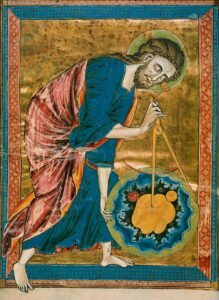
“A 13th century painting (the artist is not mentioned in the reference book) in the Austrian National Library shows the Deity as ‘The Great Architect of the Universe circumscribing Heaven and Earth’. (source: themasonictrowel.com)
John Calvin (1509-1564) was a French theologian, pastor and reformer of the Church who first published his work ‘Institutes of the Christian Religion‘ in 1536. In this work, Calvin repeatedly calls the Deity “the Architect of the Universe” and refers to His works in nature as “Architecture of the Universe” various times. Calvin also refers to the Deity as the “Great Architect or Architect of the Universe” in his Commentary on Psalm 19. (source: AQC 101. p146)
“In His hand He took the golden Compasses prepared … to circumscribe This Universe” is a sentence from John Milton‘s Paradise Lost (VII, p.224) published in 1667.
The phrase entered Freemasonry in the first Book of Constitutions of the first or premier Grand Lodge of England in 1723, The Book of Constitutions was written by the Reverend James Anderson (a Scottish Presbyterian Church minister):

Another painting depicting the Deity using a compass is by William Blake (1757-1827), an English poet and artist. Blake’s painting is titled ‘The Ancient of Days‘. There are (at least) 6 slightly different colour variants on display in various museums.
↓ It’s the image on the left.

Wallace McLeod, an eminent Canadian Masonic scholar, discusses T.G.A.O.T.U. in his book The Grand Design (1991).
SUPREME BEING
While many of the foundational concepts of Freemasonry are influenced by the Christian teachings, Freemasonry is not a addendum or offshoot of Christianity. There is (at least in theory) a very clear distinction between the Christian God and the GAOTU, and faith in one does not equate to a belief in the other.
In general people chose to interpret ‘Supreme Being’ as:
– a personal / personified God
– a living ‘thing’
– a particular and discrete ‘unit’ that exists
– the existence of something considered apart from its properties
The word “Architect” perhaps makes one think along those lines.
AN ALTERNATIVE INTERPRETATION
Being a Pantheist (← see article on Roel’s World), not believing in ‘God’ as separate ‘entity’, ‘unit’ or deity, the common interpretation(s) first seemed problematic. One doesn’t want to feel like a hypocrite or pretender, joining a Brotherhood not fully committed to it’s ideals. ‘Supreme Being’ was well-chosen in Freemasonry though, there is (perhaps unintentional) more to it then just the common interpretations mentioned above.
When consulting several dictionaries (Cambridge, Merriam-Webster, The American Heritage Dictionary of the English Language) the noun ‘being‘ can also be interpreted as:
– the state of existing
– the totality of existing things
These meanings of ‘being’ gave me enough ‘wiggle room’ to be able to interpret GAOTU in another way then an ‘entity’ separate from ”the ALL”.
GAOTU can therefore also be synonymous for a ‘Supreme existence of the Universe‘ (Spinozism, Naturalist Pantheism). GAOTU being the totality of all existing things changes the perspective (a perspective also found in the Kybalion, Kabbalah, Tao, Buddhism, Pantheism).
It may also be interpreted more abstractly in philosophy and spirituality:
– Supreme Essence: In many Eastern philosophies (like Advaita Vedanta) and mystical traditions, the term can refer to the Atman or the “true self”. This is the idea that the deepest, most essential part of a person is divine or identical to the ultimate reality.
– Supreme Existence: This aligns with the concept of Pure Being or Ontos. It refers to the fundamental state of existing before any personal traits, labels, or physical forms are added.
Essentially shifting the focus from a “personified God” to the “highest state of reality” or the “core of one’s nature.”
SYMBOL OF GAOTU
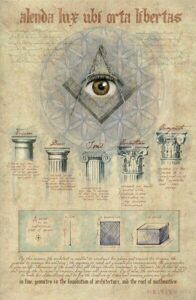
Even though considered a Christian symbol, the ‘Eye of Providence‘ (also know as the ‘All Seeing Eye’) is commonly used to symbolize GAOTU. It first appeared as part of the standard Freemason iconography in 1797 with the publication of Thomas Smith Webb‘s The Freemason’s Monitor. In this use, the Eye, representing the all-seeing eye of ‘GAOTU’, serves as a reminder that humanity’s thoughts and deeds are always observed. Typically, the Masonic Eye of Providence has a semicircular glory below it, and is sometimes enclosed by a triangle.



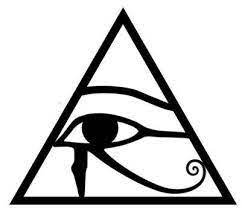
The Christian version (2nd) has the Trinity Light beams. The Freemasonry version (3rd) is a fusion between the Eye of Providence and the Square and Compasses. Originally the Eye of Horus (4rd) was depicted without a triangle, the triangle was added in Occultism in the 20th century.
Sources:
- Wikipedia (various pages)
- freemasonscommunity.life
- themasonictrowel.com
- Digital Freemasonry
- Cambridge, Merriam-Webster, The American Heritage Dictionary of the English Language
