
The History of Freemasonry & Music
With music as one of the primary topics of writings on Roel’s World, I had to share something about the relationship of Freemasonry with music. Music has been an integral part in Freemasonry from its inception in the early years of the eighteenth century. The inclusion of songs set of music in James Anderson’s first edition of ‘The Constitutions of the Freemasons‘ (1723), see pages 75 – 96, is clear evidence of this.
Musical instruments, however, were unusual in the seclusion of the Masonic lodge, which, according to tradition at the time, met in the private upper room of a tavern. Here music-making was limited to a relatively small repertoire of songs, sung to simple unaccompanied harmonies, not only during the work of the lodge, but also during the communal meal midway through the meeting and in the informal time after the lodge closed.
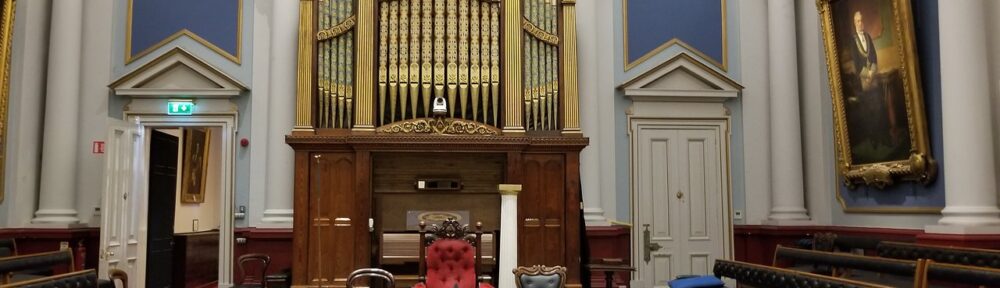
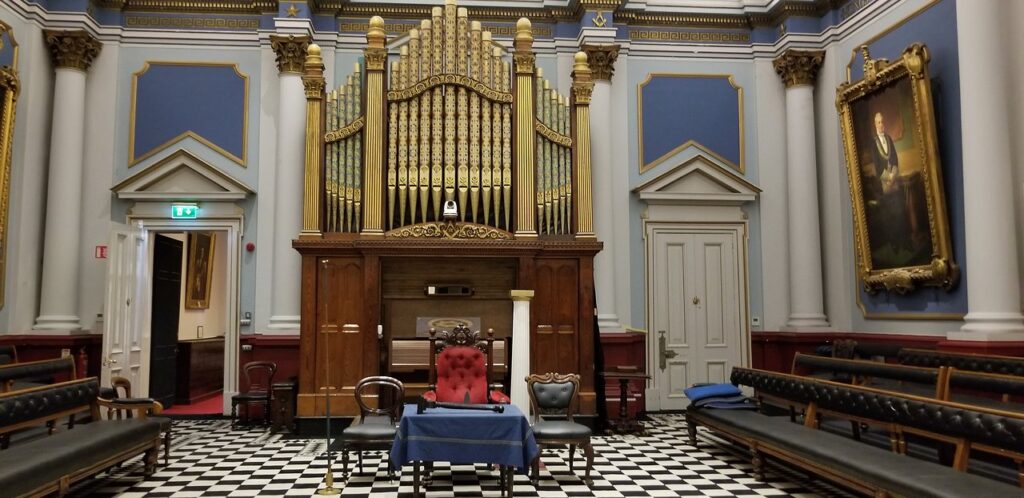
The pipe organ appeared in English Freemasonry with the upcomming of regional Masonic halls in the late eighteenth century, but the incentive for the placement of an organ in these halls was commercial (for rental of the hall) rather than Masonic.
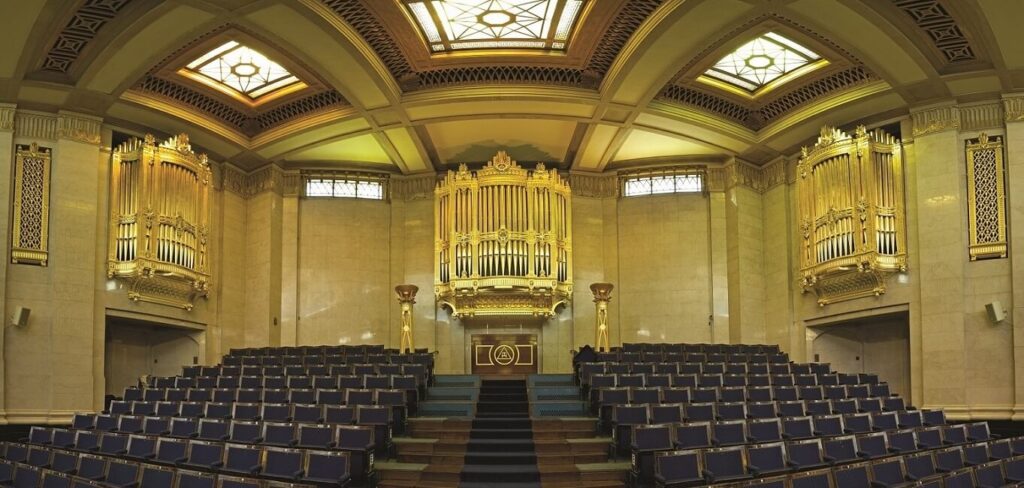
In the nineteenth century, many English Masonic lodges moved from meetings in taverns to their own local, purpose-built Masonic halls where a pipe organ had become a standard. While the tradition of appointing a Lodge organist lives on, the heyday of the pipe organ in Masonic lodges (c. 1850-c.1950) is long gone and pipe organs have steadily disappeared from lodges. Newly build halls or halls rented by Lodges no longer contain organs. An Organist in his authentic role, though more rare in modern times, keeps that tradition and traditional atmosphere alive. There is something about live music that gives another dimension to an experience.
Nowadays – especially in the absence of an actual Organ – the position is also called “Director of Music”. In the Netherlands the titel ‘Kapelmeester’ (alike Kapellmeister in German and Chapelmaster in English) is used.
What does the ‘Director of Music’ (Chapelmaster) do?
What an Organist does is pretty clear. The main difference between the ‘Organist’ and the ‘Director of Music’ is that the Organist is actually a musician, while the Director of Music doesn’t have to be a musician per say.
So, what does a ‘Director of Music’ do?
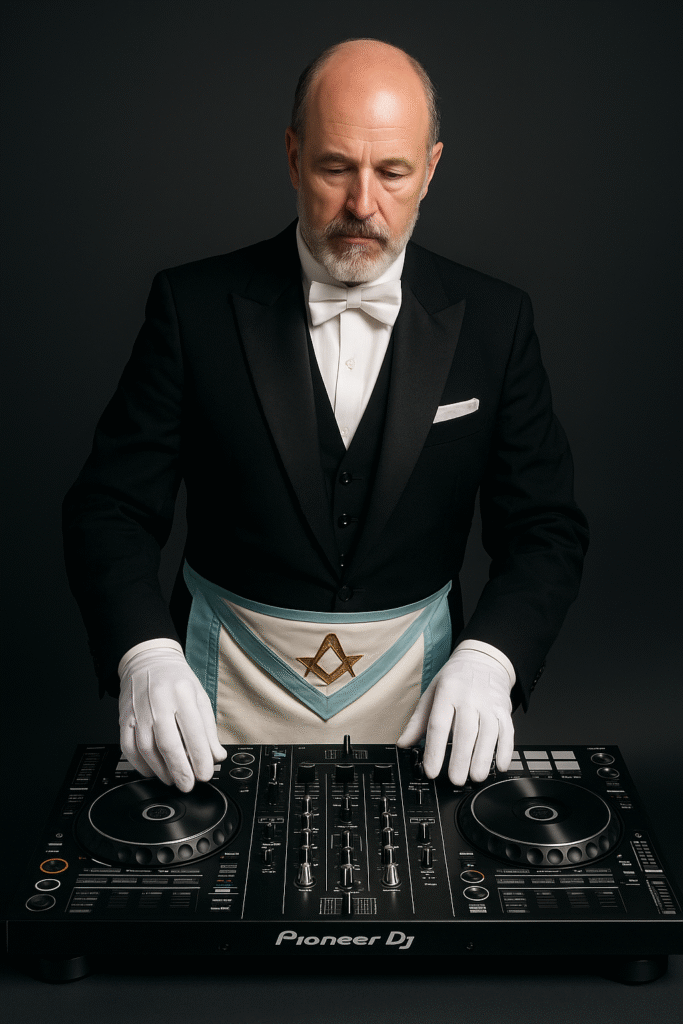
Nowadays with all sorts of equipment available and due to the absence of organs in loge buildings music in Lodges is often played through a sound system.
The Director of Music thus plays music from a medium (like CD) or a device (laptop + controller). The Organist has taken the role of a ‘Disk Jockey’ (DJ). The title ‘Director of Music’ makes thus more sense the ‘Organist’ or the mundane title of ‘DJ’.
With these modern tools the Director of Music has virtually unlimited choices in selecting and playing music that enhances the actual experience of a ritual or ceremony.
Personally – being a former musician (saxophonist) besides composer and sound engineer – and chosen as Director of Music at my Lodge, I enjoy the greater freedom of using modern ‘tools’ instead of playing the organ.
The importance of Music
That music was – and is – of great importance was something some the greatest minds in history knew. ‘Musica’ isn’t by chance one of the 7 Liberal Arts. In many Lodges studying the 7 Liberal Arts is the traditional and recommended way to gain more knowledge in the pursuit of wisdom.
In the work of “the ancients,” there is a greater understanding of Music. “Music teaches the art of forming concords (accord, consensus, concurrence, unity) so as to compose delightful harmonies by the mathematical and proportional arrangement of acute, grave and mixed sounds.”
“There is geometry in the humming of the strings, there is music in the spacing of the spheres.” – Pythagoras
“The highest goal of music is to connect one’s soul to their Divine Nature, not entertainment.” – Pythagoras
“Music is a moral law. It gives soul to the universe, wings to the mind, flight to the imagination, and charm and gaiety to life and everything.” – Plato
Henry Ward Beecher frequently discussed music in his sermons and writings, viewing it as a powerful force for good. He often used music as a metaphor for happiness and spiritual upliftment, emphasizing its ability to cleanse, inspire, and elevate the understanding. Beecher believed that music, like a well-tuned piano, reflects the state of one’s inner being and can be a means of expressing deep emotions and connecting with something larger than oneself.
“Music cleanses the understanding; inspires it, and lifts it into a realm which it would not reach if it were left to itself.” – Henry Ward Beecher
In the Kybalion, a study of the Hermetic Philosophy of Ancient Egypt and Greece, there are several principles that music relates to.
2. The principle of correspondence. “As Above, So Below. This principle embodies the truth that there is always a correspondence between the laws and phenomena of the various planes of being and life.” Musica Universalis (a concept by Pythagoras) explains the distance (intervals) between the tones of the musical tuning system is similar to the distance between the planets of our Solar system.
3. The principle of vibration. “Nothing rests; everything moves; everything vibrates.” Music is an expression of the vibratory nature of the universe. Music is vibration experiences by our senses (hearing and touch).
4. The principle of polarity. “Everything is dual; everything has poles; everything has its pair of opposites; like and unlike are the same; opposites are identical in nature, but different in degree; extremes meet; all truths are but half-truths; all paradoxes may be reconciled.” Though less common, ‘Polar Harmony’ (sometimes called ‘negative harmony) can be use to substitute chords (reharmonize music) with in primarily Classical music and Jazz.
5. The principle of rhythm. “Everything flows, out and in; everything has its tides; all things rise and fall; the pendulum-swing manifests in everything; the measure of the swing to the right is the measure of the swing to the left; rhythm compensates.” Rhythm is one of the 3 ‘pillars’ of music (rhythm, harmony and melody). Without rhythm, one one form or another, there is no music.
What music to use for rituals and cemenonies
The rituals and ceremonies offer few literal references to music in a lodge. Music is mentioned only as one among the Seven Liberal Arts and indirectly by discussion of the five senses (hearing). Selecting proper music is thus a matter of understanding the rituals / ceremonies (their symbolic meaning) and ‘good taste’.
In my opinion the most useful musical genres are: Classical, Ambient, Meditation/New-Age and Cinematic. Having a broad musical horizon, I do sometimes include World Music or even contemporary music (a Jazz ballad for example). As long as it is complementary to the ritual work, there are in theory no boundaries. There are though some things to keep in mind:
- It is not the task of the Organist or Director of Music to ‘impress’ the attending Brethren with his personal taste or musical preferences. It’s not a concert or personal performance – as common in the mundane world. The execution of this task should all be ‘in service’ of the ritual work in the Temple.
- Taste is rather subjective, keep in mind that musical preferences are as diverse as the number of Brethren attending. Music that is of experimental nature (Avant Garde) or otherwise more ‘eccentric’ might not always be felt and understood by the Brethren attending. Using only one musical genre or period might feel monotone, boring, uninspirational. As with everything in life, it is all about finding the right balance …
- Using well-know compositions might not be preferable, unless specifically composed for the ritual work in the Temple. Music has the beautiful quality of triggering memories, including memories from our mundane live experiences. Mundane memories that surfice during the ritual work and contemplation in the Temple, might be an (unpleasantly) distraction. There are countless beautiful less known / unknown musical pieces available. With original music choices one could create a new experience and memory for – and broaden the musical horizon of – the Brethren attending.
- The use of vocal music with lyrics can be ‘tricky’. Unless specifically written for a ritual or ceremony, the lyrics might not express the ritual work fully and could thus be distracting, make one ‘wonder off’ in different directions, away from meaning of the ritual work in the Temple. Instrumental music is preferable.
- Be aware of the acoustics of the Temple. In large halls and halls with lots of corners, pillars et cetera, sound may ‘bounce’ of these surfaces in an unpredictable manner. Low frequencies might become ‘trapped’ in corners, or may make certain materials (like wooden panels) resonate. Music with heavy bass or up-tempo rhythms might not always sound well. It might be useful prior to the ritual work to play the music in the Temple to check and if necessary change your playlist.
- When preparing your playlist, try to normalize (peak normalization) all musical pieces using editing software, so the maximum peak volume of each piece is the same. That makes real-time adjustments in volume a lot easier.
- Not all musical pieces might be of the preferred playing time. Some pieces might be too long, others too short. If one uses a controller or DJ-gear, one could real-time deal with this. If one does not use such hardware it might be wise to edit (shorten, extend or rearrange) the piece in advance with sound editing software.
Masonic Music & Masonic Composers
There are several kinds of Masonic Music.
1) The first and most important kind is the ‘ritual masonic music” that is composed to be played during Masonic rituals and ceremonies. Those composed for masonic rituals began to be published in the 18th century, including music written by Georg Benda, Ignaz Pleyel, François-André Danican Philidor, Johann Gottlieb Naumann, Johann Christian Friedrich Hæffner and Christian Gottlob Neefe. Anthems and other works for use in masonic lodges were written by the 18th century William Boyce and in the 19th century Albert Lortzing.
A famous example are Mozart‘s ‘Maurerische Trauermusik‘ (Masonic Funeral Music) and the collection of compositions “Masonic Ritual Music: For Male Voices and Piano or Organ” by Jean Sibelius. French composer André Gedalge wrote the anthem for the International Order of Freemasonry Le Droit Humain, with lyrics by his wife Amélie André-Gedalge, who was initiated at Lodge No.1 of Le Droit Humain in 1907.
2) The second kind is music written my Freemasons, but not for ritual purposes. These compositions are believed to have references to Freemasonry. A good example is Mozart’s opera The Magic Flute and his incidental music to Thamos, King of Egypt.
Other famous classical composers that were Freemasons are: Johann Christian Bach (The son of the famous Johann Sebastian Bach), Franz Joseph Heydn, Franz Liszt, Rouget de Lisle, John Philip Sousa and Jean Sibelius.
Not only classical composers were Freemasons, also contemporary musicians and composers contributed to the Masonic Music collection. Among them the famous Jazz musicians Duke Ellington (Prince Hall Freemasonry & Shriner) and Irving Berlin. It is uncertain if the Masonic philosophy was reflected in their music though.
Well known contemporary / popular musicians and Freemasons are Rick Wakeman and Brad Paisley.
Often the inventor of the saxophone (an instrument I am very passionate about, have blogged about and – last but not least – use to play professionally) called ‘Adolphe Sax‘ is said to have been a Freemason in various sources, but there’s no definitive documentation to confirm he was initiated. His name appeared on a petition for initiation into the “Les Vrais Amis de l’Union” lodge, but there is no historic documentation that mentioned that initiation actually took place.
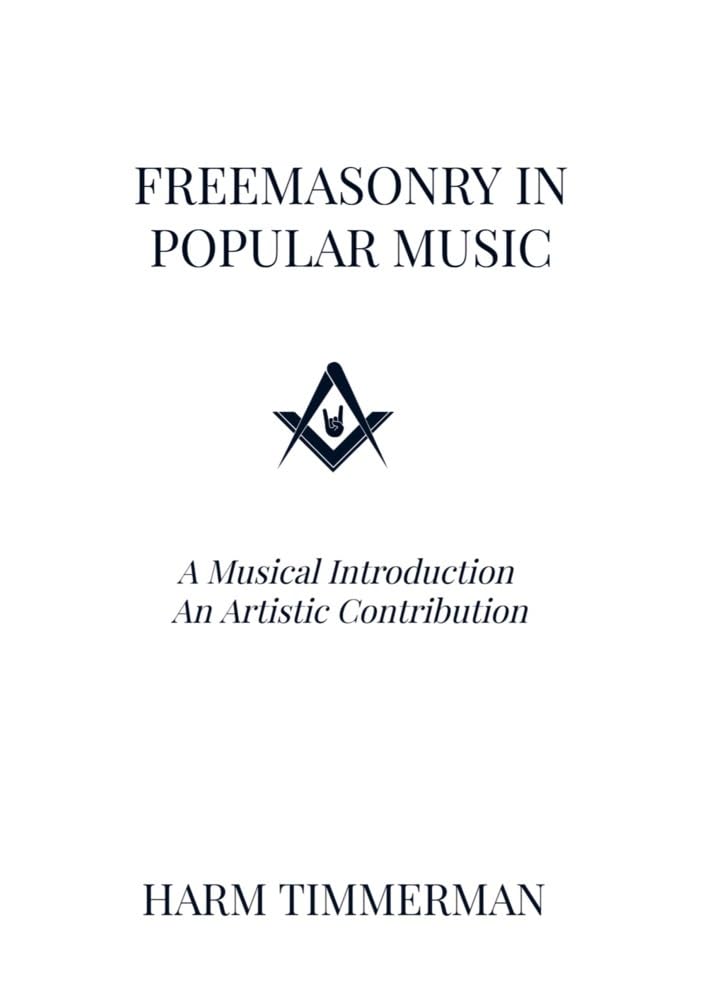
A nice book named “Freemasonry in Popular Music” (Freestone Publishing, Brave New Books – IBSN 9789464807820) by Bro. Harm Timmerman might be to your liking, if you wish to dive deeper into the relationship between Freemasonry and Music.
Lodges associated with musicians and ‘Special Interest Lodges’ for music.
In the context of Freemasonry in England, several lodges are specifically associated with musicians:
St. Cecilia Lodge No. 6190, which was founded by by several leading masonic musicians in 1945 and continues to promote the enjoyment music within Freemasonry.
Music Lodge No. 9919 in Cardiff, which is active in promoting music and community engagement.
Chelsea Lodge No 3098 was consecrated on 19 May 1905 and its members have represented most branches of show business including music hall, variety, circus, pantomime, comedy, magic, ventriloquism, silent films and talkies, cinema, radio and television, not to mention musicians who were members of British dance bands and orchestras.
The Rock Music Lodge No.10052, consecrated in 2024, is a unique Lodge celebrating rock music. Originating from the electrification of instruments, rock music evolved from American Southern Blues and Gospel into rock and roll in the 1950s and 1960s.
The Sir Edward Elgar Lodge No. 9837‘s objective is to “celebrate the heritage & gift of music” and, as the flagship music Lodge for the Province of East Kent, they support the Provincial Choir, encourage and support new organists, and all musicians and singers.
Pro Musica Lodge 9547 Special interest: musical performance
Might be a nice to watch after this article?
Sources:
- English Masonic Lodges, Pipe Organs and National Heritage – Andrew Pink, January 2007
- freemasonry.network
- various Wikipedia pages
Bro. Roelant Hollander, ‘Director of Music’ of Lodge 303, De Gulden Regel (The Golden Rule), Apeldoorn, G.O.N. The Netherlands
