
The Astrological Zodiac & Musical Tonality – Part 2 – A Historical Time-line
Historical Tone Zodiac Variants:
PTOLEMY | MARSILIO FICINO | RUDOLF STEINER | MAX HEINDEL | ANNY VON LANGE | SIGISMUND VON GLEICH | MARIUS SCHNEIDER | ALAIN DANIELOU | STOCKHAUSEN | HENSHEL & HENSHEL-FISHER | MCMULLIN | ASPECTS, SIGN-GROUPS, MODES & DEGREES | JOHANNES KEPLER | RUDOLF HAASE | SUMMERY TIMELINE
THE TONE ZODIAC (A HISTORICAL TIME-LINE)
It is only half a millennium after Pythagoras that there is evidence of a “Tone-Zodiac”, in Ptolemy’s writings. At that basis of the connection between music and the Zodiac lies the Pythagorean-Platonic vision of heavenly harmony. The “Tone-Zodiac” is a system that combines a Tone Circle with the Zodiac Circle and is by far the easiest method to visualize the connection between the Zodiac and musical tonalities.
PTOLEMY (c. 100 – c. 168 CE)
(img. Godwin, 1993: 30)
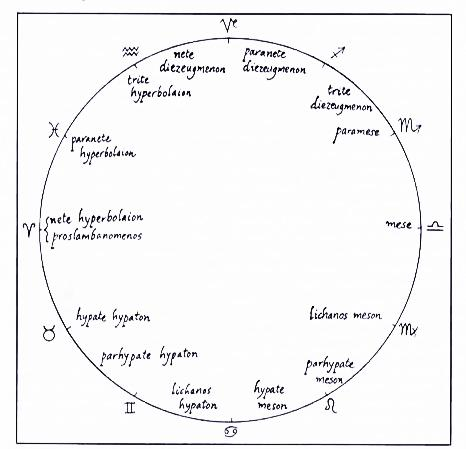
Ptolemy explains the astrological aspects by invoking music as an analogy, following Pythagorean ideas about the role of the ratios.
He presents his tone-zodiac in chapter 8 of book III of “The Harmonics“, written near the end of his life, around 168 CE.
He lays out a two-octave Pythagorean scale on a zodiac circle, noting that the rotating movements of the stars are all circular and regular and similar to the movements within the tone-system.
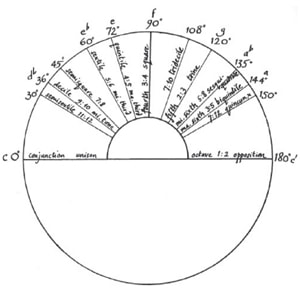
In this form of the tone-zodiac, the octave (2:1) comes opposite in the circle, and so cuts it in two (1:2), which he considers ‘a great mystery’. To the modern sense of consonance it seems strange to portray opposition by the octave and conjunction by the double octave.
This Tone-Zodiac has the following Tone-Sign combination:
 |
 |
 |
 |
 |
 |
 |
 |
 |
 |
 |
 |
||||||
| A | B | C | x | D | x | E | F | G | A1 | B1 | C1 | x | D1 | x | E1 | F1 | G1 |
This Tone-Zodiac starts at Aries with A and goes around the Zodiac circle counterclockwise (as is common with Astrology).
Ptolemy continues his argument in “The Harmonics” with a comparison of the rising and falling motion of stars with the genera in music. This comparison, based on the tropics, connects the Seven Greek Modes with the twelve star signs (image below: Godwin, 1993, p. 36):
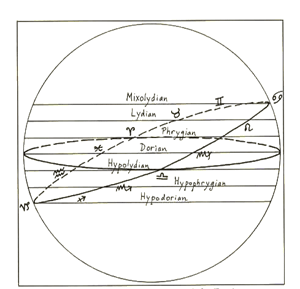
This comparison, based on the tropics, connects the Seven Greek Modes with the twelve star signs:
- Gemini () & Cancer (): Mixolydian (B)
- Taurus () & Leo (): Lydian (C)
- Aries (): Phrygian (D)
- Pisces () & Virgo (): Dorian (E)
- Aquarius () & Libra (): Hypolydian (F)
- Scorpio (): Hypophrygian (G)
- Capricorn () & Sagittarius (): Hypodorian (A)
This Tone-Zodiac has the following Tone-Sign combination:
 |
|||||||||||
| D | C | B | B | C | E | F | G | A | A | F | E |
The Circle with the Zodiac Signs is drawn clockwise, (instead counterclockwise as is common in Astrology) and starts with Aries at D. The way the Signs are grouped in the image (on what “line” the signs are placed) is not logical. There are several ways to “group” Zodiac signs (traditionally grouped in: Polarities, Triplicities, Quadruplicities) but the “grouping” seen in the picture does not match any. Later in this article more about these groups.
(Godwin, 1993, p. 36)
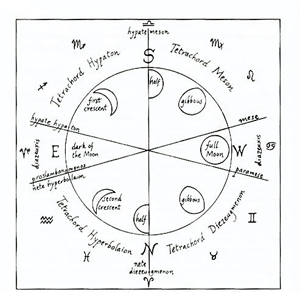
Ptolemy also presented a tone-zodiac of two octaves showing the course of the moon as well, exemplifying that of all the planets, from its conjunction with the sun at the dark of the moon.
As this chapter survives only in very corrupt manuscripts it is not very useful not go into detailhere (source: Godwin 1993, p. 36, 416). But it does show that the concept of the tone-zodiac, in different forms, was well-known to Ptolemy.
The used musical scale in the image on the left is the same as in the image with the first shared Ptolemy Tone Zodiacs. This Tone-Zodiac has the following Tone-Sign combination:
|
|||||||||||
| E | D | C | B/A | G | F | E | D | C | B/A | C | D |
Above we see the “Perfect Immutable System” (diatonic genus) that combines the “Greater Perfect System” and the “Lesser Perfect System. The “Perfect Immutable System” is divided into 4 “tetrachords“, each diatonic tetrachord consists of two intervals of a tone and one of a semitone.
The “Tetrachord Diezeugmenon” contains the tones E (Nete diezeugmenon at Aries), D, C and B.
The “Tetrachord Meson” contains E (Hypate Meson at Libra), F, G and A.
The “Tetrachord Hypaton” contains the tones E (Hypate Meson at Libra), D, C and B.
The “Tetrachord Hyperbolaion” contain the tones E (Nete diezeugmenon at Aries), D, C and B.
In this Tone Zodiac the Cardinal Directions were added as well. If the Tetrachords were implemented correctly, we find E at both North (Aries) and South (Libra). The East (Capricorn) is “sidelined” by “Hypate Hypaton” (B) and “Proslambanomenos” (A) / “Nete Hyperbolaion” (A), the West (Cancer) is “sidelined” by “Mese” (A) and “Paramese” (B). These “sidelines” connect diametrically to the same tone on the other side of the Tone Zodiac.
The Tone Zodiac starts at Aries with E and goes around counterclockwise (as is common in astrology).
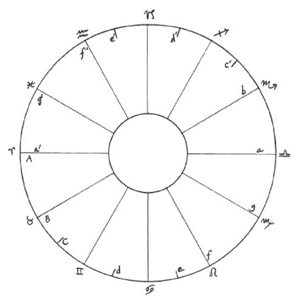
In the Ptolemaic Tone-Zodiac on the left (Godwin, 1993) only the 7 tones of the Diatonic Scale (white key tones on the piano) of A-Minor (A-B-C-D-E-F-G) have been noted, covering two octaves to complete the circle counterclockwise (as is common in Astrology). What is interesting though about this Tone-Zodiac is that not all tones align with the cusps of the signs. In this Tone-Zodiac the C, D, and E are placed in the center of the sign sector. That might “suggests” that we are looking at a 12-Tone Equal Tempered (Chromatic) circle with only some tones high-lighted.
What is interesting though about this Tone-Zodiac is that not all tones align with the cusps of the signs. In this Tone-Zodiac the C, D, and E are placed in the center of the sign sector. That might “suggests” that we are looking at a 12-Tone Equal Tempered (Chromatic) circle with only some tones high-lighted.
Or, perhaps we are looking at a Tone-Zodiac that shows a single scale. When we write the tones only (not the tonalities) that are positioned at the cusps of each sector we get the following scale: A-B-C♯-D♯-F-G, a Hexatonic or Whole-Tone scale of A.
This Tone-Zodiac has the following Tone-Sign combination:
|
|
|
|
|
|
|
|
|
|
|
|
||||||
| A/A1 | B | C | x | D | x | E | F | G | A | B | C1 | x | D1 | x | E1 | F1 | G1 |
This Tone-Zodiac starts at Aries with A and goes around the Zodiac circle counterclockwise (as is common with Astrology).
After Ptolemy ancient and medieval scholars in Western Europe discussed the connections between the planetary movements to the musical scale, but not to the zodiac.
In the Italian Renaissance the tone-zodiac surfaces again.
MARSILIO FICINO (1433-1499)
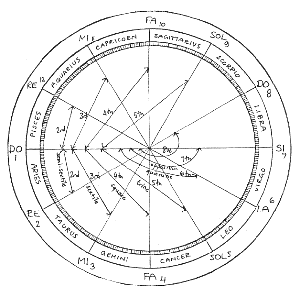
Marsilio Ficino, standing on Ptolemy’s shoulders, adds something new. In his letter to the musician-philosopher Domenico Benivieni he allows for a connection between the astrological houses and the musical intervals on the basis of the astrological aspects (source: Godwin, 1993, p. 168, Voss 2006: 186).
In his tone-zodiac he uses a one-octave scale and places the major seventh as the opposite aspect. However, he manages to keep the Ptolemaic consonances of whole-tone (sextile), fourth (square) and fifth (trine) in the same place (source: J. Godwin 1993, p. 32).
Voss argues that Ficino is advocating in his letter a tuning system in accordance with contemporary practice and the requirements of musicians, and which correlates more exactly with astrological law (source: A. Voss 2006, p. 187). As Ficino was a practising astrologer and a musician himself he may have chosen to adapt the Ptolemaic tone-zodiac to fit his own practice.
This Tone-Zodiac has the following Tone-Sign combination:
|
|||||||||||
| C | D | E | F/A | G | A | B | C | G | F/A | E | D |
If Ficino was using the “Movable-Do” system, this Tone-Zodiac would display the Major scales with “Do” reprecenting the “Tonic” of the scale. If Ficino was using the “Fixed-Do” system, then this Tone-Zodiac would represent the scale of C Major. Ficino follows the circle diatonically (7-tone white note scale) counterclockwise (as is common in Astrology).
In the “Age of Enlightenment” no new tone-zodiacs appear.
The renewed interest in the esoteric wisdom of antiquity in the romantic times of the later nineteenth century reintroduces the idea, which flowers in the Theosophical and Anthroposophical movements.
RUDOLF STEINER (1861–1925)
(image: Godwin 1987, 147)
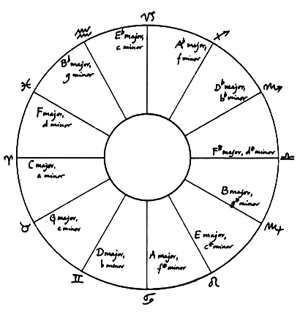
The Anthroposophical Tone-Zodiac, based on the ideas of Rudolf Steiner (the founder of Antroposophy) does not only connected the star signs with the major and minor keys, but represented the twelve creative figurations of the Archangels, the Seraphim and Cherubim, so that each tone existed as sound and as inner experience on the Etheric and Astral levels.
“All spiritual experience resulted from the awareness that the number of planets was contained in the seven scales, and the number of signs in the Zodiac was contained in the twelve fifths within the seven scales. The great mystery of man was revealed in the Circle of Fifths.” (Rudolf Steiner)
This Tone-Zodiac has the following Tone-Sign combination:
|
|||||||||||
| C | G | D | A | E | B | F♯ G♭ |
D♭ | A♭ | E♭ | B♭ | F |
| Am | Em | Bm | F♯m | C♯m | G♯m | D♯m E♭m |
B♭m | Fm | Cm | Gm | Dm |
Rudolf Steiner’s Tone-Zodiac starts at Aries with C (and A minor) and goes around the Circle of Fifths counterclockwise (as is common with Astrology).
MAX HEINDEL (1865-1919)
(image: Godwin)
Max Heindel (born Carl Louis von Grasshoff) was a Danish-American Christian occultist, astrologer, mystic and Rosicrucian Institute.
Max Heindel and Rudolf Steiner met in 1907 in Berlin and Heindel sat-in on several lectures of Steiner and spoke with him several times. Heindel did develop his own teachings Western Wisdom Teachings, very different from that of Steiner.
This Tone-Zodiac has the following Tone-Sign combination:
|
|||||||||||
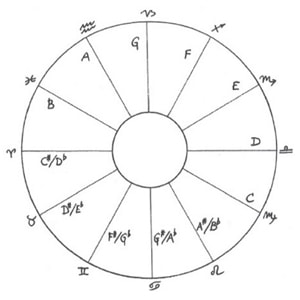
| C♯/D♭ | D♯/E♭ | F♯/G♭ | G♯/A♭ | A♯/B♭ | C | D | E | F | G/A | A | B |
His Tone-Zodiac starts at Aries with C♯ and goes counterclockwise around the Zodiac Circle.
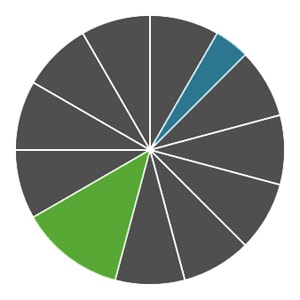
There is though an “odd thing” going on with this Tone-Zodiac. Most sections of this Zodiac covers 2 semitones per 30°. But, the section that belongs to Taurus (from D♯/E♭ to F♯/G♭) covers 3 semitones and the section that belongs to Scorpio(from E to F) only covers 1 semitone.
This means that the drawing of Max Heindel’s Tone Zodiac is incorrect. In the image on the left you can see how the Tone-Zodiac should have been divided based on the number of semitones as based on the noted tones.
If you analyze the tones used, we can form two Hexatonic (whole tone) scales with it:
Gb-Ab-Bb-C-D-E and F-G-A-B-C#-D#. Is that what Max Heindel had in mind?
The “problem” with the Hexatonic scale is that it closes a circle in 6 steps, not in 12 steps, as with the Chromatic Circle and the Circle of Fifths. This could explain why two of the sections (Taurus and Scorpio) are different in size, to be able to “close the circe” with two Hexatonic scales in the same circle. This is though a “fix” that is not logical or correct not from a musical standpoint, nor from a mathematical or geometric point of view. The circle (when drawn with sections equal in size to the intervals between the tones) does not look very “aesthetic” (something common for Taurus), the largest section in the circle.
Depending on the source the Taurus-Scorpio axis could represent one of various things such as: desires (in the sense of ownership, possession), the intensification and stabilization of the self and its environment, “Axis of True Being” (the confrontation of the self with its shadow), et cetera. Perhaps the axis of Taurus and Scorpio had special meaning to Max Heindel and that is why he chose to start the Hexatonic scales from these two signs?
There is only one “right way” to use Hexatonic scales as basis for a tone circle though. You can only use the Hexatonic scales as basis for a mathematically and musically correct tone circle if you use a tone circle with two concentric rings. Saxophonist John Coltrane drew the only functioning Hexatonic Tone Circle in existence. You can read more about that in the article “The Coltrane Tone Circle“.
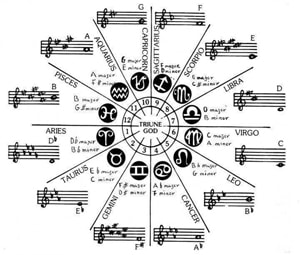
MAX HEINDEL TONE-ZODIAC “REPRODUCTION”
This Tone Zodiac image is one of the most shared Tone Zodiacs on the internet. I had difficulties finding out who made it (and I still don’t know), but when I analyzed this Tone-Zodiac I recognized the discrepancies in the tone-spacing.
This Tone-Zodiac is a “reproduction” of the Tone-Zodiac made by Max Heindel shown above.
ANNY VON LANGE (1887-1959)
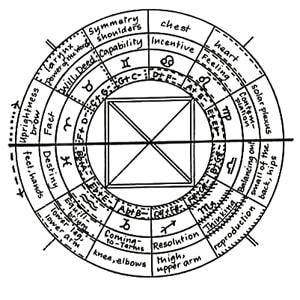
Rudolf Steiner’s Student Anny von Lange worked her ideas out for her book “Man, Music and Cosmos” (1956).
On her tone-zodiac she writes: “Twelve heavenly spheres are portals for the incoming cosmic forming forces which work upon man, each in its own appointed way.” (von Lange 1992, p. 309)
This Tone-Zodiac has the following Tone-Sign combination:
|
|||||||||||
| F | C | G | D | A | E | B | F♯ | C♯ | A♭ | E♭ | B♭ |
| Dm | Gm | Cm | Fm | B♭m | E♭m | G♯m | C♯m | F♯m | Bm | Em | Am |
Anny von Lange’s Tone-Zodiac starts at Aries with F (and D minor) and goes around the Circle of Fifths clockwise (as is common in music with the Circle of Fifths). It is important to note that the minor tonalities listed at von Lange’s Tone-Zodiac are NOT the minor relative tonalities of the listed Major tonalities! The tonic of the minor tonalities are a descending Fourth apart from the tonic of the Major tonalities, instead of a descending minor Third.
SIGISMUND VON GLEICH (1896-1953)

In the book “Über die Wirkung der Tonarten in der Musik “(About the Effect of Tonalities in Music)” by Sigismund von Gleich we find a rather original drawing of the Tone-Zodiac, in the shape of a lemniscate.
This concept is based on the idea that there is a “mirror-relationship” between the Major and minor tonalities.
The 12 tones are divided into two groups, a group of connected Major tonalities (C-G-D-A-E-B) directed outwards going “up-around-and-down” the left part of the lemniscate, followed by a group of connected Major tonalities (Gb-Db-Ab-Eb-Bb-F) directed inwards going “down-around-and-up” the right part of the lemniscate. The minor tonalities follow the same movement in opposite direction. You could say that the Major and minor tonalities “mirror” each others movement. Libra – the only tonality with an equal number of sharps (#) and flats (♭) is located at the crossing between both sides of the lemniscate.
Within this Tone-Zodiac design you can see a Lenmiscate Ouroboros, (the tail-devouring snake).
This Tone Zodiac Lemniscate has the following Tone-Sign combination:
|
|||||||||||
| C | G | D | A | E | B | F♯ G♭ |
D♭ | A♭ | E♭ | B♭ | F |
| Am | Em | Bm | F♯m | C♯m | G♯m | D♯m E♭m |
B♭m | Fm | Cm | Gm | Dm |
This Tone Zodiac follows the Circle of Fifths and starts with Aries at C Major (on the left) and A minor (on the right) of the lemniscate and goes around in both clockwise and counterclockwise movements.
This Tone-Sign combination is the same as Rudolf Steiner’s.
MARIUS SCHNEIDER (1903-1982)
TONE ZODIAC
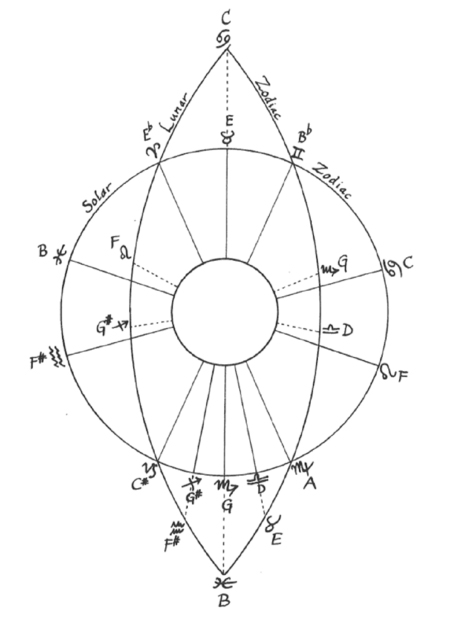
SOLAR-LUNAR TONE ZODIAC
TONE ZODIAC SPIRAL
Marius Schneider was a musicologist who created an entirely original system that traces its origin to the world-wide spiritual culture of the Megalithic era (Godwin 1987, p. 149). His work is full of tone-zodiacs, some very creative and original, when looking at the Tone-Zodiacs by Marius Schneider it is obvious we are looking at the work of a unique individual.
SCHNEIDER’S TONE ZODIAC
(1st Zodiac above)
This Tone-Zodiac starts at Aries on C and go around the circle counterclockwise. The intervals between the tones differ though.
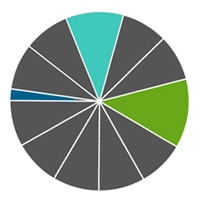
Most of the sections cover Major Thirds (4 semitones) except for Virgo (from A♭ to D) covering 6 semitones, Sagittarius (from B♭ to E♭) covering 5 semitones and Pisces (from B to C) – covering 1 semitone.
This means that the drawing of Marius Schneiders’ Tone Zodiac (as provided by Godwin) isn’t mathematically drawn correct. In the image on the right you can see how the Tone-Zodiac should have been divided based on the number of semitones as based on the noted tones.
|
This Tone-Zodiac has the following Tone-Sign combination:
|
|||||||||||
|
C |
E |
A♭ |
D♭ |
F |
A |
D |
F♯ |
B♭ |
E♭ |
G |
B |
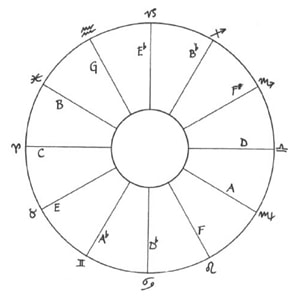
This Tone-Zodiac is probably the most “complicated” in design that I have come across. It combines a “Solar Zodiac” (circle) and what Schneider called a “Lunar Zodiac” (ellipse).
The intervals between the tones placed on the Tone Zodiacs and the size of the “sectors” do not match and that means that the drawing of Marius Schneiders Solar-Lunar Tone Zodiac (as provided by Godwin) is mathematically incorrect. To make a Tone-Zodiac for this concept that is mathematically drawn correct and still “pretty-looking” is probably out of the question.
But, we can appreciate it for it’s creative design, originality and the astrological idea behind it!
|
This Tone-Zodiac has the following Tone-Sign combination:
|
|||||||||||
|
E♭ |
E |
B♭ |
C |
F |
A |
D |
G |
G♯ |
C♯ |
F♯ |
B |
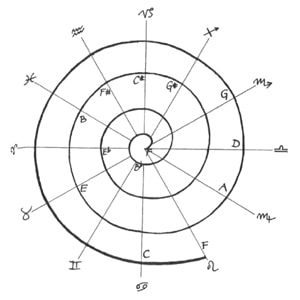
TONE ZODIAC SPIRAL
(3rd Zodiac above)
That Schneider was a creative thinker becomes very clear with the “Tone-Spiral” – called the “Form of Cosmic Evolution” – the 12 tones are placed on a Spiral according to the astrological quadruplicities.
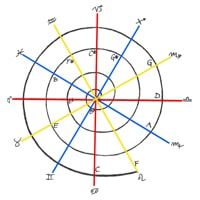
Within this sign-group the Zodiac Signs are divided in 3 Modes. The Signs from the same Mode form a Square or a Cross.These Modes are: CARDINAL (Aries, Cancer, Libra and Capricorn), FIXED (Taurus, Leo, Scorpio and Aquarius) and MUTABLE (Gemini, Virgo, Sagittarius and Pisces).
|
This Tone-Zodiac has the following Tone-Sign combination:
|
|||||||||||
| Eb | E | Bb | C | F | A | D | G | G# | C# | F# | B |
Later in this article you will find more information about the “Zodiac sign-groups” and an example with squares.
ALAIN DANIÉLOU (1907-1994)
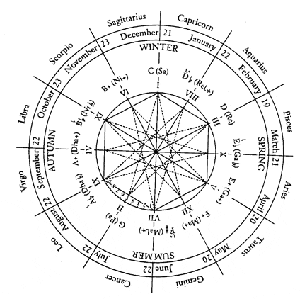
This Tone Zodiac shows the correspondences of the 12 tones with the Zodiac signs, months and seasons. The names for the notes are in Indian, though the Tone Zodiac is ancient Chinese (from the book “Music and the Power of Sound” by Alain Daniélou).
The order of succession of the Fifths is pointed-out by the points of the dodecagram (12-point star) and numbered I-XII (Roman numerals). Each tone is connected by a dotted lines to its upper Fifth and its lower Fifth.
The notes that correspond to the angles of the hexagon are masculine (C–D–E–F#–Ab–Bb), the notes that correspond to the middle of the sides are feminine (Db–Eb–F–G–A–B), forming two Hexatonic or Whole-Tone scales.
|
This Tone-Zodiac has the following Tone-Sign combination:
|
|||||||||||
|
E♭ |
E |
F |
F♯ |
G |
A♭ |
A |
B♭ |
B |
C |
D♭ |
E |
This Tone-Zodiac is uses the Chromatic circle and goes round clockwise. C relates to Capricorn as Aries (the Western starting point) relates to Eb.
STOCKHAUSEN (1928-2007)
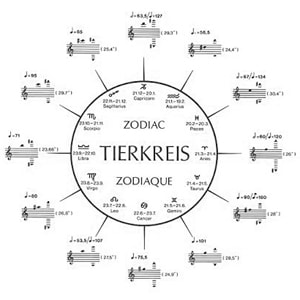
1975 – German composer Karlheinz Stockhausen wrote a musical composition in 1975 called “Tierkreis” (Zodiac in German). Stockhausen was a student of Schönberg, abandoning the seven uneven steps of the major scale to the twelve equal notes of dodecaphony and serialism.
The Tierkreis melodies are constructed on several series that rule pitch and duration. The “zentraltöne” of the melodies form a chromatic scale. The tempos of melodies are ordered like a chromatic scale.
|
This Tone-Zodiac has the following Tone-Sign combination:
|
|||||||||||
|
F |
F♯ |
G |
G♯ |
A |
A♯ |
B |
C |
C♯ |
D |
D♯ |
E |
Karlheinz Stockhausen used the Chromatic Circle, starting at Aries with F, following the circle clockwise (as is common in music with tone circles) in semitone-steps.
HENSCHEL & HENSCHEL-FISHER
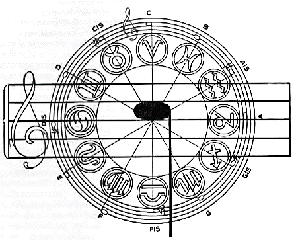
1954 – Tone-Zodiac by Joan Henschel and Mary Henschel-Fischer (musicologist). They see their own times as chaotic and urge change, expecting the Age of Aquarius to bring about the joining of music, mathematics and astrology in the true universal religion.
Joscelyn Godwin has pointed out their “poor astrology” and “dubious musical results“, such as calling the perfect fifth and fourth “dissonant” intervals (source: Godwin 1987, p. 142).
|
This Tone-Zodiac has the following Tone-Sign combination:
|
|||||||||||
| C | C♯ | D | D♯ | E | F | F♯ | G | G♯ | A | A♯ | B |
The Henschels use the Chromatic Circle, starting at Aries with “C”, following the circle counterclock-wise (as is common in Astrology) in semitone-steps.
MCMULLIN
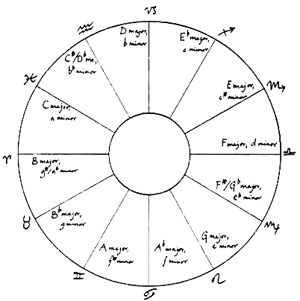
(image: Godwin)
The Irish astrologer and musicologist Michael McMullin sees Carl Jung as one of the great teachers of our age. His Tone-Zodiac dates from (1984).
“One can say that the voice of God has come to the West not through organized religion but through music, and that music’s great ‘bodhisattvas’, or avatars have been the messengers of a higher reality.” (McMullin 2006)
|
This Tone-Zodiac has the following Tone-Sign combination:
|
|||||||||||
| B | B♭ | A | A♭ | G | F♯/G♭ | F | E | E♭ | D | C♯/D♭ | C |
| G♯m/A♭ | Gm | F♯m | Fm | Cm | E♭m | Dm | C♯m | Cm | Bm | B♭m | Am |
Michael McMullin used the Chromatic Circle, starting at Aries with B, following the circle counterclockwise in semitone-steps down the chromatic scale.
CREDITS
For the historical “time-line” about the Tone Zodiacs I have quoted Eduard Heyning from his essay “The Tone-Zodiac Symbol“. I did make a few changes and added some footnotes. If you like that part of this blog article, then you might like his essay about the Tone Zodiacs (and more) on academia.edu as well, or visit www.tierkreis.nu (about Stockhausen).
The images used are mostly copies from “Harmonies of Heaven and Earth: Mysticism in Music from Antiquity to the Avant-Garde” by Joscelyn Godwin, completed with images from the work of Sigismund von Gleich, Alain Daniélou, Karlheinz Stockhausen and Henschel. I have modified several tone-circle images that were shared online and added a few of my own.
! ROEL’S WORLD INTERPRETATION & IMPLEMENTATION !
With some concepts (such as Kepler’s Tone Zodiac) the astrological, astronomical and/or mathematical values have been the starting point to build a Tone Zodiac. This sometimes mend that music came ‘second’ in order to make a concept work. Important to me though is to be sure the functions of the intervals, the meaning of tones, scales and tonalities are preserved and not “re-interpreted” to prove an otherwise mathematical correct concept with.
In the article “The Astrological Zodiac & Musical Tonality – Roel’s Interpretation” I wrote in more detail about the tone-sign combination that I think is the most cogent.
Introduction
Tone-Zodiacs

OTHER SOURCES / REFERENCES PART 1-4:
- “Harmonies of Heaven and Earth: Mysticism in Music from Antiquity to the Avant-Garde” (by Joscelyn Godwin)
- “Über die Wirkung der Tonarten in der Musik” (by Sigismund von Gleich)
- “Writings on Music” (by John Wallis)
- “Mensch, Musik und Kosmos” (by Anny von Lange)
- www.tonalsoft.com – Encyclopedia of Microtonal Music Theory
- www.flutopedia.com – Color of Sound calculator
- http://wiki.astro.com/astrowiki/ (AstroWiki)
- http://en.wikipedia.org/wiki/Zodiac (Wikipedia)
- http://en.wikipedia.org/wiki/Seasons (Wikipedia)
- http://en.wikipedia.org/wiki/Planets_in_astrology (Wikipedia)
- http://en.wikipedia.org/wiki/Tierkreis_(Stockhausen) (Wikipedia)
