
The Astrological Zodiac & Musical Tonality – Part 3 – Aspects, Grouping, Modes & Degrees
ASTROLOGICAL ASPECTS, SIGN-GROUPS, MODES AND DEGREES
“Opposition“, “Trine” and “Square” are commonly used terms by astrologers to define important relative positions of planets. Every aspect relates to a particular number of degrees. Opposition = 180°, the Trine = 120° and the Square = 90°. More information about some of these “Zodiac sign-groups” will follow later in this article. For now I will focus on the degrees and how they relate to the Tone-Zodiac.
Kepler is said to have been impressed – as Ptolemy before him – by the fact that these three most powerful aspects are expressed by the same ratios as the three perfect consonances in music.
| ASPECT | DEGREES | RATIO CIRCLE | RATIO INTERVAL |
 Opposition Opposition |
180° | 360:180 = whole circle to half | 2:1 = Octave |
 Trine Trine |
120° | 360:240 = whole to greater part | 3:2 = Perfect Fifth |
 Square Square |
90° | 360:270 = whole to greater part | 4:3 = Perfect Fourth |
JOHANNES KEPLER (1571-1630)
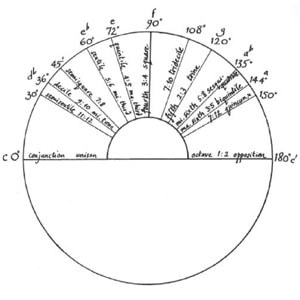
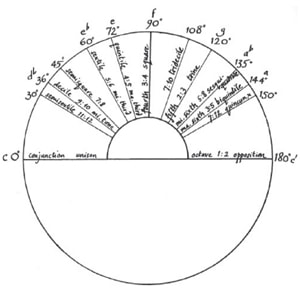
In his Tone-Zodiac (image: Godwin) Johannes Kepler places the Unison (Tonic) and Octave across (opposite) each other with all aspects in between, as if the Zodiac represented a hypothetical monochord string, in other words a logarithmic scale. The musicians among the readers of this article will undoubtedly frown looking at it, as did Rudolf Haase (see below).
Even though quantitatively perfect, it still did not match the astrological qualities with the qualities of the intervals. The most obvious example is the “opposition“, one of the more tension-producing (disharmonious) aspects in Astrology. The great challenge of the opposition is to integrate the two poles. At Kepler’s Tone-Zodiac the Unison and the Octave have been placed in opposition with each other.
The distance (interval) between the Unison and Octave in music though, is the most consonant (tension-free or “harmonious“) of all intervals. They are so harmonious, that when you play them together, it becomes very difficult to separate them from each other. They instantaneously “become one” to the listener.
What we see in Kepler’s Tone-Zodiac, is the incompatibility of musical and astronomical distances, the incomparability between the logarithmic scale of the monochord (on which equal divisions produce increasing intervals) with the geometry of a circle divided into 360 equal degrees.
The astrological website www.astro.com offers a free “Sound Horoscope” based on Kepler’s concept. Personally I would not recommend using this “Sound Horoscope”. If they – like Kepler – use the Unison and Octave (most harmonious interval, tension-free) as “opposition” (much tension), then they obviously do not know much about sound and music theory!
Personal footnote: At first I was thrilled when I came across Kepler’s concept, I thought “I stroke gold” and had found the answers I had been looking for. But when comparing the functions of the intervals and their particularities to the aspects related to the degrees, I was a bit disappointed, they didn’t truly match. Not much later I saw I had not been the only person that felt that way, Rudolf Haase has done so way before me. Rudolf Haase thus suggested an alternative scheme for the degree-based Tone-Zodiac:
RUDOLF HAASE (1920–2013)
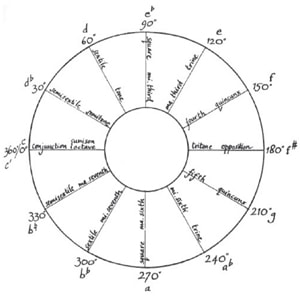
German musicologist Rudolf Haase aligned the placement of the 12 tones with the standard division of the Zodiac circle, where each sector of the circle is 30°, much alike 12-Tone Equal Temperament, that is represented by a circle of 1200 cents, divided into 12 Equal sectors of 100 cents per semitone.
The opposition is now the dissonant Tritone while the Unison and Octave coincide. The Major Third (an interval with an “optimistic” character) aligns with the (positive) Trine (120°) while the Minor Third (an interval with a somewhat “pessimistic” character) aligns with the (negative) Square(90°). Haase also mentions that in modern times even the semitone and Major Seventh are treated as consonant just as their aspects the Sextile (60°) and Semi-Sextile (30°).
Not all aspects can be used in this circle The “Decile” (36°), “Semisquare” (45°), “Quintile” (72°), “Tridecile” (108°), “Sesquiquartile” (135°) and Biquintile (144°) are not part of the scheme.
You might also have noticed that no Zodiac Signs have been drawn into this Tone-Zodiac. The focus point of this scheme is not the Tones, but the Intervals, as it is with the “Movable Do” system. This scheme can be used for every tonality.
SUMMERY HISTORICAL TIME-LINE
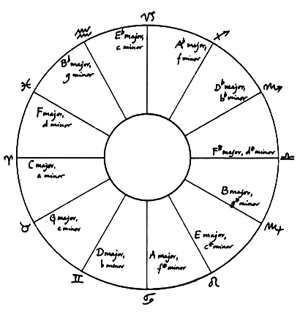
After reading some books, lectures and online articles and “studying” various Tone-Zodiacs, I noticed that the Circles (Scales) and tonalities used differs a lot as you can see in this summery:
|
KEY→ |
C | C♯ D♭ |
D | D♯ E♭ |
E | F | F♯ G♭ |
G | G♯ A♭ |
A | A♯ B♭ |
B |
| CC | 1 | 1 | 1 | 1 | ||||||||
| C.O.F | 2 | 1 | ||||||||||
| VARIOUS | 2 | 2 | 1 | 2 | 1 | 4 |
This means that looking into the past did not give us an unambiguous answer to the question: “What tonality relates to what Zodiac Sign”?
Later in this article I will share my own view on it. I will first proceed with some additional information about Astrological Modes and the Zodiac Signs & Colors.
GEOMETRY & GROUPS: POLARITIES, TRIPLICITIES, QUADRUPLICITIES & DUALITIES
I mentioned “grouping” of the Zodiac Signs during the historical time-line. So what are those “groups”?
| POLARITIES (opposition – 180°) |
TRIPLICITIES (trine – 120°) |
QUADRUPLICITIES (square – 90°) |
 |
 |
 |
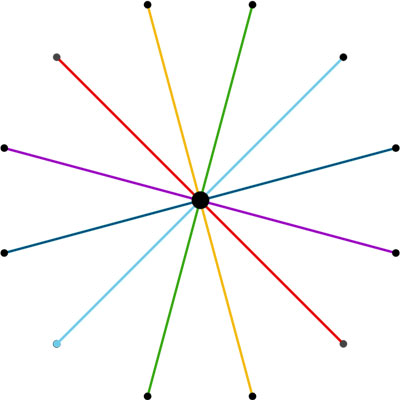
NOTE: the colors used in these examples are just to differentiate between the sign-groups based on the mode-division. The proper tone-color combination can be found later in this article!
CIRCLE OF FIFTHS & THE ZODIAC CIRCLE and their SHAPES, DEGREES, INTERVALS:
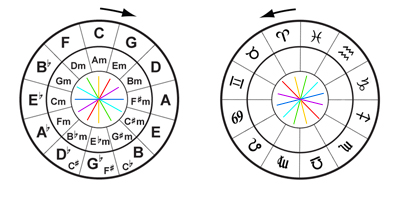
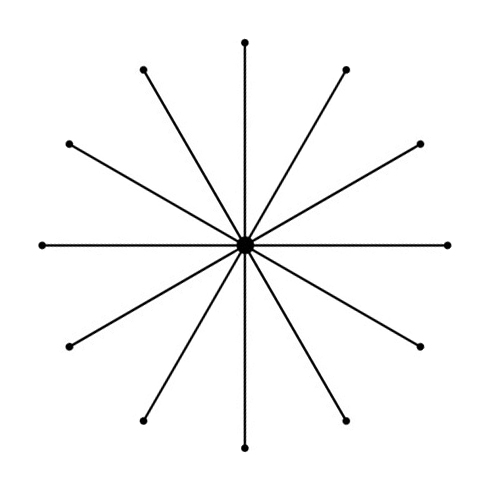
LINE: POLARITIES
Opposition (180°), 6{2}
The opposition causes exaggeration as it is not unifying.
The “connected” (opposite) tones in the Circle of Fifths are a “Tritone“ apart from one another: C-G♭, G-D♭, D-A♭, A-E♭, E-B♭ & B-F.
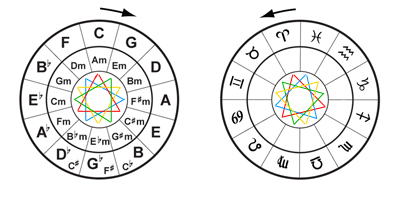
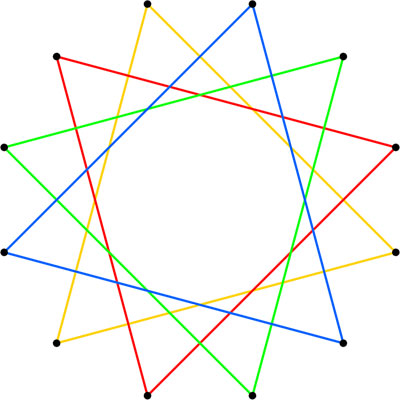
TRIGON: TRIPLICITIES (THE 4 ELEMENTS) Trine (120°), 4{3}
The trigon, triangle or trine indicates harmony and ease.
 FIRE: Aries, Leo and Sagittarius
 EARTH: Taurus, Virgo and Capricorn
 AIR: Gemini, Libra and Aquarius
 WATER: Cancer, Scorpio and Pisces
The clockwise “connected” tones in the Circle of Fifths are a Major Third apart from one another:
C-E, E-A♭ & A♭-C / G-B, B-E♭ & E♭-G D-G♭, G♭-B♭ B♭-D / A-D♭, D♭-F F-A. Counterclockwise the “connected” tones in the Circle of Fifths are a Minor Sixth apart.
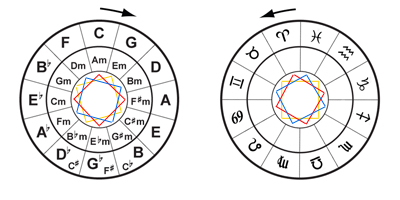
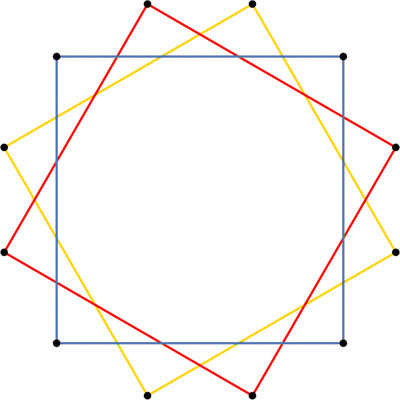
SQUARE: QUADRUPLICITIES (THE MODES) Square (90°), 3{4}
 CARDINAL: Aries, Cancer, Libra and Capricorn
 FIXED: Taurus, Leo, Scorpio and Aquarius
 MUTABLE: Gemini, Virgo, Sagittarius and Pisces
The counterclockwise “connected” tones in the Circle of Fifths are a Minor Third apart from one another: C-E♭, E♭-G♭, G♭-A & A-C / B♭-D♭, D♭-E, G-B♭ / F-A♭, A♭-B, B-D & D-F. Clockwise the “connected” tones in the Circle of Fifths are a Major Sixth apart.
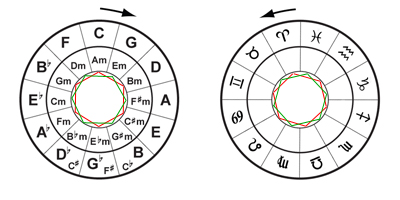
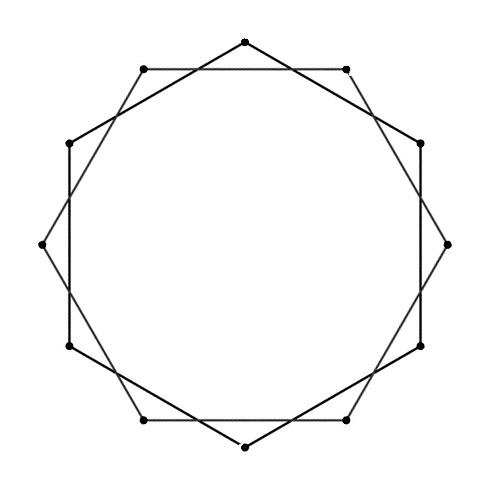
HEXAGON: DUALITIES (♂ & ♀)
 Sextile (60°), 2{6}
Representing “masculine and feminine” or “positive and negative” (+ & –).
The Sextile represents “ease of communication” between the elements involved, with compatibility and harmony between them. The Zodiac signs can be divided into two groups of 6 signs:
MASCULINE SIGNS: Fire + Air signs
FEMININE SIGNS: Earth + Water signs
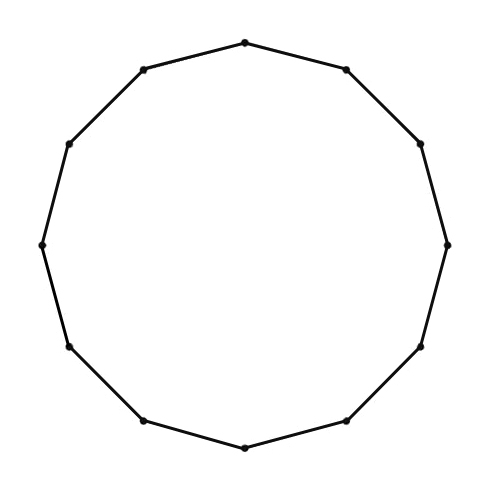
The “connected” signs form two Hexatonic or Whole Tone Scales when combined: C–D–E–F♯–G♯–A♯–C and G–A–B–D♭–E♭–F–G. The tone distances up the scale, represent the Whole Tones. Naturally going down a whole tone (Major Second) is “equal to” going up the Scale a Minor Seventh (10 Semitones). The Hexagon thus represents both the Major Second (Whole Tone) and Minor Seventh.
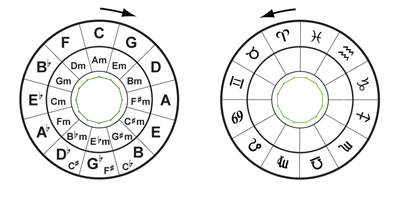
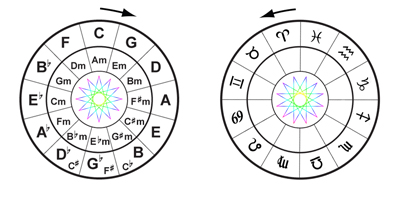
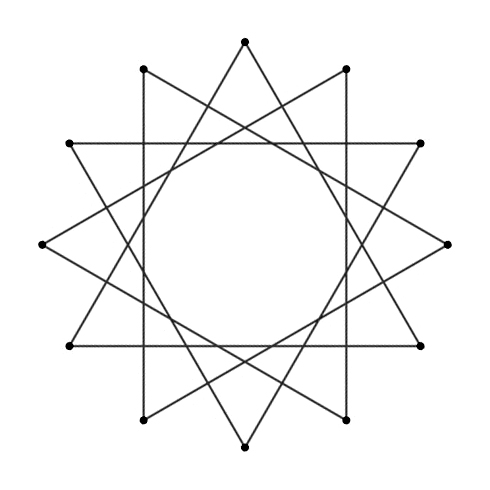
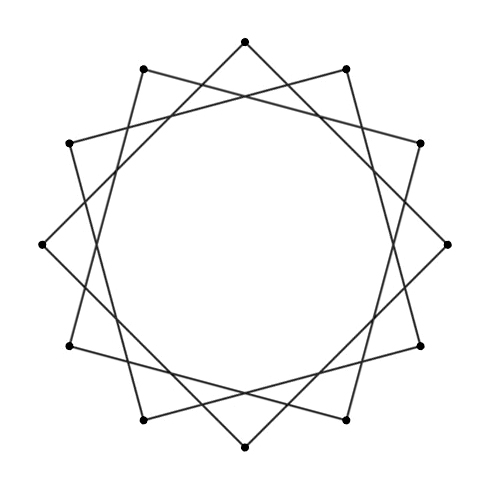
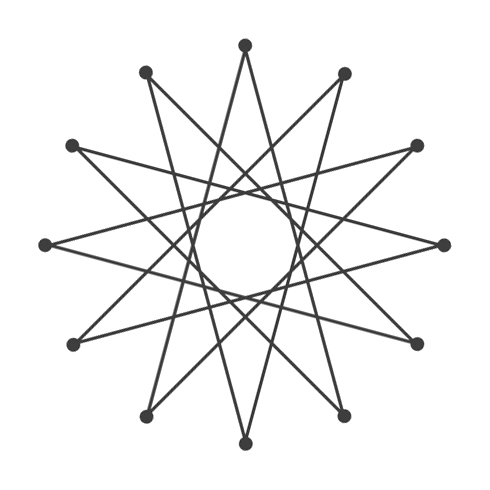
DODECAGRAM  Quincunx (150°), t{6/5}={12/5}
The Dodecagram is – like the Dodecagon – not one of the traditional 3 “groups” but does represent an aspect called the “Quincunx“.
When you follow the lines of the Dodecagram across, you “traverse” chromatically up or down the Chromatic Scale. Naturally going a Minor Second (semitone) down the Chromatic Scale is “equal to” going a Major Seventh (11 semitones) up the scale. The Dodecagram thus represents both the Minor Second (Semitone) and the Major Seventh.
OTHER ASPECTS
The “Decile” (36°), “Semisquare” (45°), “Quintile” (72°), “Tridecile” (108°), “Sesquiquartile” (135°) and Biquintile (144°) are not part of this scheme. These aspects fall in between the intervals we use in the 12-Tone (Equal Tempered) musical tuning.
Below all aspects that relate to musical intervals used:
| LINE | TRIGON | SQUARE | HEXAGON | DODECAGON | DODECAGRAM | |
 |
 |
 |
 |
 |
 |
|
| 6{2} | 4{3} | 3{4} | 2{6} | t{6} | t{6/5}={12/5} | |
| C C |
TRITONES | MAJOR THIRDS |
MINOR THIRDS |
MAJOR SECOND |
MINOR SECOND MAJOR SEVENTH |
FIFTHS FOURTHS |
| C o F |
MINOR SIXTHS | MAJOR SIXTHS | MINOR SEVENTH | FIFTHS FOURTHS |
MINOR SECOND MAJOR SEVENTH |
|
| Opposition | Trine | Square | Sextile | Semi-Sextile | Quincunx | |
|
|
|
|
 |
|
|
| 180° | 120° | 90° | 60° | 30° | 150° | |
|
“POLARITIES“
|
“TRIPLICITIES“
|
“QUADRUPLICITIES“
|
“DUALITIES“
|
 Masculine
 Feminine
 The degrees listed above relate to the angles of 2 dots relatively to each other from the center point of the geometric shapes. With these geometric “shapes” combined, all possible tone-connections can be made, as is clear from the superimposed graph. Naturally this counts only for 12-Tone systems.
CHROMATIC CIRLCE
If you use the Chromatic Circle instead of the Circle of Fifths (as used for the examples above), then the sign-groups (Polarities, Triplicities and Quadruplicities) and the Hexagon align with the Signs and Tones in a similar manner as they do with the Circle of Fifths.
There is one difference though. With the Circle of Fifths the Dodecagon connects the Fifths/Fourths and the Dodecagram visualizes the Chromatic Scale, but if the Chromatic Circle is used, the Dodecagon would visualize the Chromatic Scale and the Dodecagram would connect the Fifths/Fourths instead.
OTHER MUSICAL INTERVAL SYSTEMS
Not all Musical Interval Systems contain 12 tones. With a different number of tones different geometric “shapes” need to be used. Some of the Tone-Zodiacs presented earlier in this article (like those by Ptolemy) use for example only 7 tones (Greek modes). For Tone-Zodiacs using 7 tones or scale degrees you could use the Heptagram and Heptagon.
THE CHROMATIC SCALE, THE PIANO AND THE MONTHS OF THE YEAR
There is yet another way to connect keys / tonalities with Zodiac signs. The Western tone system has 12 tones, as there are 12 Zodiac signs and 12 months. The 12 months do not contain the same numbers of days. There are 7 months with 31 days, and 5 months with less (30 or 28/29), as there are 7 white keys and 5 black keys.
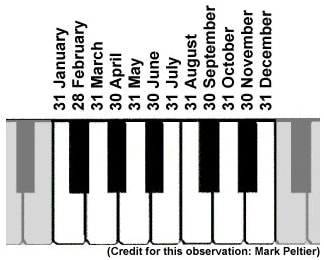
If we examine the following order of keys of the piano (and the Chromatic Scale), then there are 2 places where on the piano two white keys are next to each other, between B and C and E and F.
Much alike the division of the months, December and January and July and August are the only two moments in the year that 31-day (white key) months follow each other directly.
Even more interesting is that both piano keys and months follow the same pattern:
Starting from January 31:less = White:Black = 7:5 = 4:3 + 3:2
Starting from tone C White:Black = 31:less = 7:5 = 3:2 + 4:3
There is though one thing to keep in mind … the Zodiac Signs do not align with the months of our calendar. Each sign starts and ends around the 20th (18-23th) of each month. There are thus 2 variants possible.
The first variation aligns to key / tonality with the start of the Zodiac signs (Decan 1) and is as shown in the image above (by Mark Peltier). The second variation aligns with the a sign with the largest coverage of a month (Decans 2 & 3).
Every Zodiac Sign covers 30 Degrees of the Zodiac Circle. Every Zodiac Sign is divided in 3 Decans, each of 10 degrees. It is said that the 1st Decan (0-9 degrees) corresponds to the physical side and relates to the body, the 2nd Decan (10-19 degrees) corresponds to the mental or the Mind side and the 3rd Decan (20-29 degrees) corresponds to the spiritual aspects of a person. Astrologers could base this decision also on the actual position of the planets within the Zodiac Sign’s Decans.
|
VARIANT1 – STARTING WITH ARIES (THE FIRST SIGN):
|
|||||||||||
|
G |
G♯ |
A |
A♯ |
B |
C |
C♯ |
D |
D♯ |
E |
F |
F♯ |
|
Mar. |
Apr. |
May |
Jun. |
Jul. |
Aug. |
Sep. |
Oct. |
Nov. |
Dec. |
Jan. |
Feb. |

|
VARIANT 2 – STARTING WITH ARIES (THE FIRST SIGN):
|
|||||||||||
|
F♯ |
G |
G♯ |
A |
A♯ |
B |
C |
C♯ |
D |
D♯ |
E |
F |
|
Apr. |
May |
Jun. |
Jul. |
Aug. |
Sep. |
Oct. |
Nov. |
Dec. |
Jan. |
Feb. |
Mar. |
What variant should you use? Well, that’s up to you to decide.
Alternatively, for those who do not read astrological charts a choice for each variant could very well depend on the type of music you are making. I would suggest using variant 1 for music related to dance and other physical expressions of music and variant 2 for listening and meditative purposes.
! ROEL’S WORLD INTERPRETATION & IMPLEMENTATION !
With some concepts (such as Kepler’s Tone Zodiac) the astrological, astronomical and/or mathematical values have been the starting point to build a Tone Zodiac. This sometimes mend that music came ‘second’ in order to make a concept work. Important to me though is to be sure the functions of the intervals, the meaning of tones, scales and tonalities are preserved and not “re-interpreted” to prove an otherwise mathematical correct concept with.
In the article “The Astrological Zodiac & Musical Tonality – Roel’s Interpretation” I wrote in more detail about the tone-sign combination that I think is the most cogent.
Introduction
Tone-Zodiacs
OTHER SOURCES / REFERENCES PARTS 1-4:
- “Harmonies of Heaven and Earth: Mysticism in Music from Antiquity to the Avant-Garde” (by Joscelyn Godwin)
- “Über die Wirkung der Tonarten in der Musik” (by Sigismund von Gleich)
- “Writings on Music” (by John Wallis)
- “Mensch, Musik und Kosmos” (by Anny von Lange)
- www.tonalsoft.com – Encyclopedia of Microtonal Music Theory
- www.flutopedia.com – Color of Sound calculator
- http://wiki.astro.com/astrowiki/ (AstroWiki)
- http://en.wikipedia.org/wiki/Zodiac (Wikipedia)
- http://en.wikipedia.org/wiki/Seasons (Wikipedia)
- http://en.wikipedia.org/wiki/Planets_in_astrology (Wikipedia)
- http://en.wikipedia.org/wiki/Tierkreis_(Stockhausen) (Wikipedia)
