A philosophical, semiscientific, contemplative blog by Roelant (Roel) Hollander about Music, Sound, Saxophone, Photography, Arts, Sacred Geometry, Esoterism, Freemasonry, and more …
I recommend you read my article ‘Colour Symbolism‘ first! It provides background information about what colour is and does, insightful thoughts by Carl Jung and Bro. Goethe, and some historical references, that will place what I have written below in a broader perspective.
Colours in Freemasonry
Symbolism is one of Freemasonry’s most typical features. Its symbolism and rituals makes it unique. Though perhaps not as obvious as particular objects and forms, colour plays an important role in symbolism of Masonry as well. No matter the lack of a ‘universal’ recognisable arrangement (system) of colours in Freemasonry, the colours used aren’t arbitrary and are often derived from ancient traditions from mysteries, cultures or religions, like those referred to earlier in this article.
For the meanings of colours red, yellow, green, blue, purple, black and white in Masonry, there is no recognised scheme or science used, according to Masonic author A. E. Waite, as mentioned by Bro. Leon Zeldis in the Ars Quatuor Coranatorum (Transactions 105).
With cultures, religions (references to biblical stories), mysteries and psychology (Jung among others) in mind, it is not odd that in Freemasonry the symbolic meaning of colours are used to ‘colour’ the symbolism and allegories. Colours, in fact, are as important in Speculative Freemasonry as they were in ancient Mysteries and religions.
Blue The colour blue as described in this article so far would symbolise Blue Lodges well: ‘fidelity, truthfulness and spirituality, friendship and benevolence’.
Red Some Masonic degrees use red as base colour, much like Symbolic Lodges use blue. Like the York Ride Royal Arch degree as well as the heraldic degrees of the York and Scottish Rites. Red is also the third and final alchemical stage. Red is also the colour of Tubal-Cain.
Purple or Violet The York Rite Mark, Past and Most Excellent Master degrees combine red and blue into purple or violet (reminder of a close and harmonious relationship). Mackey suggested purple or violent symbolically being the colour of transition, from the symbolic Blue Lodges to the red of the Royal Arch. Of purple can also symbolise Union – purple being formed by the union of blue and red.
Yellow Yellow is the colour of sulphur. Yellow, or Gold, is also the colour of the Sun, a symbol common and present in every Freemasonry Temple.
Green Green is typical for Counsel degrees. The acacia (the Masonic evergreen) has been suggested as a symbol of a moral life or rebirth, and also of immortality.
White White is also is one of two colours of the checkered floor, the second alchemical stage. The Masonic apron of the Entered Apprentice (and often that the Fellow Craft too) is generally white, without symbols or decorations.
Black Black represents the depths of the Earth, V.I.T.R.I.O.L. (alchemical motto), first alchemical stage, and black is one of two colours of the checkered floor.
How are those colours used?
Colours are used for the Masonic Regalia worn during rituals and ceremonies.
“The first mention of colour that I know of is in the resolution of Grand Lodge of June 24th, 1727, by which the Worshipful Master and “Wardens of all private Lodges are ordered to wear ” the jewels of Masonry hanging to a white ribbon,” so that blue was evidently not coeval with the formation of the Grand Lodge of 1717.
The next resolution on the subject was on March 17th, 1731, by which the Master, Wardens and members of private Lodges were ordered to wear white leather aprons lined with white silk ; the Grand Stewards’ aprons and collars of red silk; and the Grand Officers to wear gold or gilt jewels pendant to blue ribbons about their necks, and white leather aprons lined with blue silk. I may also mention, as a side light on the subject, that in 1765 garters (of purple, indented with pink), are described as part of the Royal Arch clothing.
The Grand Lodge of Scotland and the Grand Orient of the Netherlands give the greatest freedom of choice to daughter Lodges. In Scotland aprons are found of every shade, and even combination, of red, blue, white, green and tartan. In Holland, with the exception of tartan [1], similar varieties are in vogue. The Grand Officers of the Grand Orient of the Netherlands use blue and gold, both in aprons and collars. In Scotland the colours in use in private Lodges are not even permanent, but appear to be changed at pleasure.
Turning to other degrees, red, and purple and crimson are specially apportioned to the Royal Arch and attendant degrees ; black to the Templars, and green or white to higher grades. Hence we hear of ” blue masonry,” ” red masonry,” ” black masonry ” etc., as a convenient way of distinguishing the component groups of such Rites as the “Early Scottish” and others.“
– Bro. F. J. W. Crowe (Art Quatuor Coranatorum Transactions 17 ‘Colours in Freemasonry‘)
In the Ancient and Accepted Rite these Masonic colours are also used for Temple decors. Colours of the Regalia and the Temple decors are matching and the colour combination used changes from degree by degree.
Bro. F. J. W. Crowe lists these colour combinations from the 4th degree up to the 33rd degree. If you are curious, do check out the Ars Quatuor Coronatorum (AQC) vol. 17 that includes the essay by Bro. F. J. W. Crowe. What follows are additional comments by Bro. Crowe’s fellow Brethren, that might be of interest to you too.
Footnotes:
Lodge “De Gulden Regel” (The Golden Rule), whom I am a member of – the only blue Lodge under the Grand Orient of the Netherlands that uses the Scottish Rites blue grade rituals – are the exception on the exception, for they are the only Lodge in the Netherlands using a tartan, the “Freemason’s Universal Tartan” to be precise.
Sources:
In Art Quatuor Coranatorum (AQC) Transactions 17 ‘Colours in Freemasonry‘ by Bro. F. J. W. Crowe
In Art Quatuor Coranatorum (AQC) Transactions 105
Color Symbolism and Freemasonry – Bro. John Shroeder, PM
Chapter XV – The Symbolism Of Colours – W. M. Don Falconer PM, PDGDC
Freemasonry – ‘Grand Architect of the Universe‘ (GAOTU)
Monotheism is considered the sole dogma of Freemasonry. Belief in a ‘Supreme Being’ is required of every initiate. Freemasonry is not concerned with theological distinctions though, thus the conception of the ‘Supreme Being’ is left to the Freemason’s own interpretation. The belief in a ‘Supreme Being’ is an important distinction that separates Freemasonry from purely secular or philosophical organizations.
This ‘Supreme Being’ is therefor often conceptualized in Masonic literature as the ‘Grand Architect of the Universe‘ (GAOTU), ‘The Grand Architect of the Universe” (TGAOTU) or the ‘Grand Geometrician‘ (not to be confused with the ‘Great Geometer’ Apollonius of Perga, who was nicknamed so). It’s a phrase with an interesting etymology, suitable with the Masonic symbolism used.
ORIGIN OF THE NAME‘GRAND ARCHITECT OF THE UNIVERSE’
In literature, art, and theology the Deity has been referred to as an Artisan, Artificer and Architect.
ARTISAN(or craftsman)
“In the Platonic, Neopythagorean, Middle Platonic, and Neoplatonic schools of philosophy, the demiurge (sometimes spelled as demiurg) is an artisan-like ‘figure’ responsible for fashioning and maintaining the physical universe. … The word demiurge is an English word derived from demiurgus, a Latinised form of the Greek δημιουργός or dēmiurgós. It was originally a common noun meaning “craftsman” or “artisan“. The philosophical usage and the proper noun derive from Plato‘s Timaeus, written c. 360 BC, where the demiurge is presented as the creator of the universe.“
“The demiurge is not necessarily the same as the creator figure in the monotheistic sense, because the demiurge itself and the material from which the demiurge fashions the universe are both considered consequences of something else.” (Wikipedia)
According to Plato this ‘Artisan’ used the Principles of Geometry to build the Universe. Naturally, ‘artisan’ and ‘architect’ are not synonyms. Early architects though were often artisans before architecture became a distinct profession. In ancient and medieval times, architects were skilled craftsmen who worked alongside stonemasons, carpenters, and builders, rather than being purely theoretical designers.
In that sense you could see Plato’s Demiurg (Artisan) as the first ‘incarnation’ of what would be known as ‘Great Architect of the Universe’.
An example from the Bible, Wisdom 13:1 (Deuterocanonical Book), God is called “the Artisan” who created the world. New Revised Standard Version: “For all people who were ignorant of God were foolish by nature; and they were unable from the good things that are seen to know the one who exists, nor did they recognize the artisan while paying heed to his works;“
In Islamic philosophy, particularly in Sufism and Kalam (Islamic theology), God is often described as an infinite craftsman who designs the universe with wisdom and order.
The Emerald Tablet, a foundational alchemical text, describes creation as a process of divine craftsmanship.
ARTIFICER
The Hermetic tradition speaks of a Divine Creator as a Grand Artificer, shaping the universe through sacred geometry and natural laws.
ARCHITECT
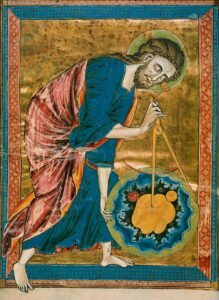
“A 13th century painting (the artist is not mentioned in the reference book) in the Austrian National Library shows the Deity as ‘The Great Architect of the Universe circumscribing Heaven and Earth’. (source: themasonictrowel.com)
John Calvin (1509-1564) was a French theologian, pastor and reformer of the Church who first published his work ‘Institutes of the Christian Religion‘ in 1536. In this work, Calvin repeatedly calls the Deity “the Architect of the Universe” and refers to His works in nature as “Architecture of the Universe” various times. Calvin also refers to the Deity as the “Great Architect or Architect of the Universe” in his Commentary on Psalm 19. (source: AQC 101. p146)
“In His hand He took the golden Compasses prepared … to circumscribe This Universe” is a sentence from John Milton‘s Paradise Lost (VII, p.224) published in 1667.
The phrase entered Freemasonry in the first Book of Constitutions of the first or premier Grand Lodge of England in 1723, The Book of Constitutions was written by the Reverend James Anderson (a Scottish Presbyterian Church minister):
Another painting depicting the Deity using a compass is by William Blake (1757-1827), an English poet and artist. Blake’s painting is titled ‘The Ancient of Days‘. There are (at least) 6 slightly different colour variants on display in various museums.
↓ It’s the image on the left.
Blake’s painting
From a French manuscript edition of “Bible Moralisee” c. 1250.
Wallace McLeod, an eminent Canadian Masonic scholar, discusses T.G.A.O.T.U. in his book The Grand Design (1991).
SUPREME BEING
While many of the foundational concepts of Freemasonry are influenced by the Christian teachings, Freemasonry is not a addendum or offshoot of Christianity. There is (at least in theory) a very clear distinction between the Christian God and the GAOTU, and faith in one does not equate to a belief in the other.
In general people chose to interpret ‘Supreme Being’ as: – a personal / personified God – a living ‘thing’ – a particular and discrete ‘unit’ that exists – the existence of something considered apart from its properties
The word “Architect” perhaps makes one think along those lines.
AN ALTERNATIVE INTERPRETATION
Being a Pantheist (← see article on Roel’s World), not believing in ‘God’ as separate ‘entity’, ‘unit’ or deity, the common interpretation(s) first seemed problematic. One doesn’t want to feel like a hypocrite or pretender, joining a Brotherhood not fully committed to it’s ideals. ‘Supreme Being’ was well-chosen in Freemasonry though, there is (perhaps unintentional) more to it then just the common interpretations mentioned above.
When consulting several dictionaries (Cambridge, Merriam-Webster, The American Heritage Dictionary of the English Language) the noun ‘being‘ can also be interpreted as: – the state of existing – the totality of existing things
These meanings of ‘being’ gave me enough ‘wiggle room’ to be able to interpret GAOTU in another way then an ‘entity’ separate from ”the ALL”.
GAOTU can therefore also be synonymous for a ‘Supreme existence of the Universe‘ (Spinozism, Naturalist Pantheism). GAOTU being the totality of all existing things changes the perspective (a perspective also found in the Kybalion, Kabbalah, Tao, Buddhism, Pantheism).
It may also be interpreted more abstractly in philosophy and spirituality:
– Supreme Essence: In many Eastern philosophies (like Advaita Vedanta) and mystical traditions, the term can refer to the Atman or the “true self”. This is the idea that the deepest, most essential part of a person is divine or identical to the ultimate reality. – Supreme Existence: This aligns with the concept of Pure Being or Ontos. It refers to the fundamental state of existing before any personal traits, labels, or physical forms are added.
Essentially shifting the focus from a “personified God” to the “highest state of reality” or the “core of one’s nature.”
SYMBOL OF GAOTU
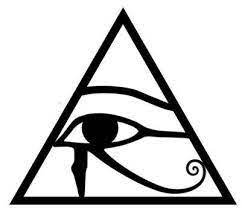
Even though considered a Christian symbol, the ‘Eye of Providence‘ (also know as the ‘All Seeing Eye’) is commonly used to symbolize GAOTU. It first appeared as part of the standard Freemason iconography in 1797 with the publication of Thomas Smith Webb‘s The Freemason’s Monitor. In this use, the Eye, representing the all-seeing eye of ‘GAOTU’, serves as a reminder that humanity’s thoughts and deeds are always observed. Typically, the Masonic Eye of Providence has a semicircular glory below it, and is sometimes enclosed by a triangle.
Standard version
Christian version
Feemasonry version
Egyptian version
The Christian version (2nd) has the Trinity Light beams. The Freemasonry version (3rd) is a fusion between the Eye of Providence and the Square and Compasses. Originally the Eye of Horus (4rd) was depicted without a triangle, the triangle was added in Occultism in the 20th century.
Sources:
Wikipedia (various pages)
freemasonscommunity.life
themasonictrowel.com
Digital Freemasonry
Cambridge, Merriam-Webster, The American Heritage Dictionary of the English Language
In various books, movies and online sources, claims have been made about the origin of Freemasonry and presumed predecessors, such as the Knight Templar and Rosicrucian’s. Let’s shed some light on those claims …
I have always been fascinated by Knighthood, Knightly Orders, The Crusades and the Knights Templar in particular, reading historical novels, history books, watching documentaries and movies since childhood.
Still a young boy, I was thrilled to learn the meaning of my name; Roelant [ roo-lahnt ] is the Dutch version of the French name Roland (pronounced in English as: roh-luh-nd or rəʊlənd ), from the Old Frankish Hrōþiland (Hroshfinand), in Medieval Latin: Hruodlandus. Hrodland meaning: hrod = “fame” or “honour”, and ‘land’ (a variation on ‘nand’) = “daring”. One of the famous Roland’s in history was a Knight, Count Roland, nephew and Paladin of Charlemagne, with his famous sword ‘Durendal‘. I found ‘La Chanson de Roland‘ particularly impressive and dreamt about being Knighted, owning a famous sword and being involved in great acts of Bravery.
While growing up I thought I was born in ‘the wrong time’ to ever become a Knight and wield a sword. It wasn’t until I was initiated into Freemasonry that I learned that ‘Knights’ (be it only by title) still existed, and wielding a sword (be it ceremonially) still happens during rituals and ceremonies. In various Masonic Rites a title ‘Knight” comes with a particular degree.
FREEMASONRY AND THE KNIGHTS TEMPLAR
“The connection of the Knights Templar with the Freemasons may much more plausibly be traced than that of the Knights of Malta. Yet unfortunately, the sources from which information is to be derived are for the most part traditionary; authentic dates and documents are wanting.“
– John R. Bennett
The earliest documented proclaimed link between Freemasonry and the Crusades is the 1737 oration of the Chevalier Ramsay. He claimed, without supporting historical evidence, that European Freemasonry came about from an interaction between ‘crusader Masons‘ and the Knights Hospitaller. The Knights Hospitaller (nowadays Sovereign Military Order of Malta) and the Knights Templar were not on good terms with one another though, and when the Knights Templar were dissolved through papal bulls and prosecution, most of their confiscated wealth was handed over to the Knights Hospitaller.
For this article I will set the Knights Hospitaller aside and focus at the Knights Templar.
Its a fascinating topic, the Knights Templar and, much like Freemasonry, veiled in Mystery. Naturally without proper documentation and evidence there is more then enough room for speculation, intriguing theories or even conspiracies. I will share one of these with you:
The Knights Templar insisted, after their establishment in 1118, on having their headquarters on the Temple Mount in Jerusalem. When Jerusalem was taken by the Saracens the Templars were forced out and moved to France. Some theories suggest that, when King Philp IV of France and Pope Clement conspired against the Knights Templar in 1307, several Templars escaped their arrest, prosecution and execution.
Mainstream historians though claim the Knights Templar Order was fully dismembered and ceased to exist. Some Masons instead propounded that after their escape the Knights Templar found refuge by sympathetic Masons and Robert the Bruce, King of Scotland. Albert C. Mackey M.D. shared in ‘Encyclopedia of Freemasonry and its Kindred Sciences‘ (p. 342 and p. 946-947) a few stories such.
At the time of the disappearance of the Templars in and around 1307, those Masonry Guilds likely resumed doing their business as usual. Freemasonry emerged several hundred years later though, that is, if we may believe various documents from that period. The oldest and most important Masonic manuscripts that suggest the existence of Freemasonry from around that time are: The Avignon Decree (1326), The Regius Manuscript (1390) and The Cooke Manuscript (1450).
What interpretation of history is true? Did the Knights Templar ceased to exist or is the Masonic account right?
Supposition: What if the Templars never left their refuge, merged the remnants of their Order with local (Masonic) Guilds, and with it gave birth to Freemasonry?
– Both Masons and Knights Templar were influenced by esoteric and early Christian believes. – Both were accustomed with initiations, secrecy, brotherhood, et cetera. – Both considered Solomon’s Temple a place of great importance. The Templars had chosen the Temple Mount in Jerusalem as the site for their sacred headquarters: it was believed that Solomon’s Temple had stood there. And Masons had actually build Solomon’s Temple, that story was of equally great importance. It should not come as a big surprise that the build of Solomon’s Temple played an important role in Masonic rituals from the 1720’s onwards, when the Master Mason Degree was presumably ‘invented’ and references to the build of Solomon’s Temple were added in the rituals.
Could these Freemasons have continued where the Knights Templar Order ended?
Or is it all Masonic Mythology and are the Knights Templar references in Freemasonry nothing but allegory and symbolism, veiled in mystery, much like allegories related to Solomon’s Temple and it’s Masonic symbolism? After all, Freemasons, unlike their Operative Mason predecessors, don’t chisel in stone in their mundane life either.
WHAT DO WE ACTUALLY KNOW FOR FACT?
Despite Freemasonry’s general disclaimer that no one regular Masonic organization actually claimed a direct heritage to the medieval Knights Templar, certain degrees and orders are obviously patterned after the medieval Order. These are best described as “commemorative orders” or degrees. Nevertheless, in spite of the fraternity’s official disclaimers, some Masons, non-Masons and even anti-Masons insist that certain Masonic rites or degrees originally had direct Templar influence.
Depending upon the geographical jurisdiction, the Knights Templar exist either as part of the York Rite or as an independent organization. Though the York Rite and the independent versions share many similarities there are key differences.
Membership of this order is open for (Master) Freemasons who profess the Christian faith and are willing to make an obligation on the Tri-Unity, and are Royal Arch Masons.
Personal note: a Knight Templar I will never be. As Dualist Pantheist I don’t profess the Christian faith and interpret the ‘Tri-Unity’ differently.
FREEMASONRY AND THE ROSICRUCIANS
From: “ROSICRUCIAN AND MASONIC ORIGINS“
For this article I have selected a few “snippets” that – to me – felt as most essential.I suggest you read the complete work!
“The secret doctrine that flows through Freemasonic symbols (and to whose perpetuation the invisible Masonic body is consecrated) has its source in three ancient and exalted orders. The first is the Dionysiac artificers, the second the Roman collegia, and the third the Arabian Rosicrucians.“
“The Dionysians were the master builders of the ancient world. Hiram, King of Tyre, was the patron of the Dionysians. The tools of the builders’ craft were first employed by the Dionysians as symbols under which to conceal the mysteries of the soul and the secrets of human regeneration. The Dionysians also first likened man to a rough ashlar which, trued into a finished block through the instrument of reason, could be fitted into the structure of that living and eternal Temple built without the sound of hammer, the voice of workmen or any tool of contention.“
“The Roman collegia was a branch of the Dionysiacs and to it belonged those initiated artisans who fashioned the impressive monuments whose ruins still lend their immortal glory to the Eternal City.“
“The Mysteries of Egypt and Persia that had found a haven in the Arabian desert reached Europe by way of the Knights Templars and the Rosicrucians. The Temple of the Rose Cross at Damascus had preserved the secret philosophy of Sharon’s Rose; the Druses of the Lebanon still retain the mysticism of ancient Syria; and the dervishes, as they lean on their carved and crotched sticks, still meditate upon the secret instruction perpetuated from the days of the four Caliphs.“
“The modern Masonic order can be traced back to a period in European history famous for its intrigue both political and sociological. The forerunner of modern thought was beginning to make its appearance and all Europe was passing through the throes of internal dissension and reconstruction.“
“So with the Masonic Mysteries of today. Each Mason has at hand those lofty principles of universal order upon whose certainties the faiths of mankind have ever been established. Each Mason has at hand those lofty principles of universal order upon pregnant with life and hope to those millions who wander in the darkness of unenlightenment. From the unprobed depths of Arabian Rosicrucianism also issued the illustrious Comte de St.-Germain, over whose Masonic activities to this day hangs the veil of impenetrable mystery. The exalted body of initiates whom he represented, as well as the mission he came to accomplish, have both been concealed from the members of the Craft at large and are apparent only to those few discerning Masons who sense the supernal philosophic destiny of their Fraternity.“
“Long before the establishment of Freemasonry as a fraternity, a group of mystics founded in Europe what was called the “Society of Unknown Philosophers.” Prominent among the profound thinkers who formed the membership of this society were the alchemists, who were engaged in transmuting the political and religious “base metal” of Europe into ethical and spiritual “gold”; the Kabbalists who, as investigators of the superior orders of Nature, sought to discover a stable foundation for human government; and lastly the astrologers who, from a study of the procession of the heavenly bodies, hoped to find therein the rational archetype for all mundane procedure.“
“Several initiated Rosicrucians were brought from the mainland to England, where they remained for a considerable time designing the symbolism of Freemasonry and incorporating into the rituals of the order the same divine principles and philosophy that had formed the inner doctrine of all great secret societies from the time of the Eleusinia in Greece.The adepts brought over from the Continent to sit in council with the English philosophers were initiates of the Arabian rites and thus through them the Mysteries were ultimately returned to Christendom.“
“Such, in brief, is the story to be pieced together from the fragmentary bits of evidence available. The whole structure of Freemasonry is founded upon the activities of this secret society of Central European adepts; whom the studious Mason will find to be the definite “link” between the modern Craft and the Ancient Wisdom. Even the casual observer must realize that the true wealth of Freemasonry lies in its mysticism.“
From Lectures on Ancient Philosophy – An Introduction to the Study and Application of Rational Procedure: The Hall Publishing Company, Los Angeles, First Edition 1929, pp 397-417
“The connection between Freemasonry and the Rosicrucians is a bit hazy at best. While they both promote similar tenets and philosophies, neither have an exact common denominator. As noted, there is no direct connection between the two. However, some claim that Freemasonry came from Rosicrucianism.“
“Some of the clear differences would be that the Rosicrucians were religious men whose doctrines were of spirits, of the elements, of numbers and heavenly bodies, and their influence on men. The Freemasons were founded by builders, whose symbols are applied in architecture and is usually described as a peculiar system of morality, veiled in allegory, and illustrated by symbols.“
“In the early 18th century, the scientific ideals of Rosicrucianism began to make their way into the progressive social contracts that formed the basis of modern Freemasonry. From that point forward, Rosicrucianism and Freemasonry worked hand in hand to promote freethinking, social progressivism, and scientific discovery.“
“Rosicrucian Freemasons do exist though, its members being Master Masons.”
– RWB Robert H. Johnson
‘Rosicrucian Freemasons’ are members (Fraters) of several Masonic Rosicrucian Orders, such as SRIA, SRIS, SRICF, The Rosicrucian Society, et cetera, all distinguished fraternities rooted in esoteric wisdom, with a mission to explore the mysteries of ancient Rosicrucian philosophy. You have to be Master Mason (Blue Lodge Freemasonry) before you can apply for membership.
“The intertwining of Rosicrucianism and Freemasonry traces back to the dawn of time. The earliest documented evidence of this connection is found in Henry Adamson’s ‘The Muses Threnodie,’ published in Edinburgh in 1638.
Many Masonic historians propose that modern Speculative Freemasonry is deeply indebted to the Rosicrucian movement.“
From: “ROSICRUCIANS, THEIR HISTORY AND AIMS With reference to the alleged connection between Rosicrucianism & Freemasonry.” Ars Quatuor Coronatorum vol. 7′ (Research Lodge Quatuor Coronati, London
“The SRIA was constituted by the late Robert Wentworth Little, well known as a prominent mason, and Secretary to the Royal Masonic Institute for Girls [ … ] but the right to the name and the inspiration which set it going was supplied by the late Kenneth R. H. Mackenzie, who, when in Germany in early life, became acquainted with descendants of the old Rosicrucian Fraternity; they admitted him to some lower grades, permitted him, as an experiment, to bring about the formation of an almost exotic society among Freemasons, and to use the midiæval German name. So much for the connection in modern times between Rosicrucians and Freemasons.“
“It is, I believe, not so seriously denied by any one that Freemasonry before 1800 was a society avowedly Christian, as well as being composed of professing Christians, so that on this ground, for one, there is some reason for the suggestion that early Freemasons were related to the Rosicrucians. The crux of the whole matter before us is that the early relation between the Societies, if any; and now there dawns upon you, possibly, the utter impossibility of ever demonstrating conclusively either the relation, or an entire distinction between Freemasonry and Rosicrucianism. The difficulties are obvious and irremovable It is hard enough to show evidence of relation between institutions which existed in a distant past.“
“Masonry a hundred years ago was Christian, in a sense at any rate, and Rosicrucian doctrine is Christian upon the face of it. This is one bond of allience, and there are others. The great principles of Freemasonry are stated to be Brotherly Love, Relief and Truth; now these are merely names for purposes which are found in the oldest Rosy Cross books to be their aims and objects: see their ‘Fama et Confessio, 1615‘.“
“I am content with Bro Gould’s dictum at p. 60 of vol. II of his History of Freemasonry: – He writes, “it is clear that the Masonic body had its origin in the trades unions of midiæval operatives,”- just so, but that statement throws no light on the origin of our Masonic Ritual, in which the terms of operative art are almost restricted to the Explanantion of the Working Tools; while other symbolism, entirely apart from the building arts, is so prominent. This other symbolism is exactly of the nature that our Rosicrucians were capable of supplying, and my contention is that they did supply it.“
“In conclusion then, Bretheren, I consider that our existant Speculative Masonry was derived from two parents, and was gradnally perfected from materials drawn from these two sources; from the Trade Guilds it obtained it’s organization and first nominal chiefs; its historic traditions and maronry being co-eval with the erection of stately edifices, and the general craft symbolism of its ritual; while from the Rosicucians, whose philosophy at that time (1650-1700) been made more popular and less esoteric, it derived all the moral philosophy, its semi-Christian ideals, and its halo of mystic secrecy. Further upon the necessarily predominant ideal of the trade guild, mutual support and protection, was grafted from the same Rosicrucian source the newly formulated but old existing ideals of universal benevolence and the search after those real truths which underlie our humanity, and have been so grievously hidden beneath our forms of religion and civilization.”
Non-Masonic Rosicrucian Orders such as AMORC (Ancient Mystical Order of the Rosy Cross or Ancient / Mystical Order Rosæ Crucis) are not related to the Masonic Rosicrucian Orders or AASR mentioned above.
THE DRUSES OF SYRIA AND THEIR RELATION TO FREEMASONRY
from: Ars Quatuor Coronatorum vol. 3 – By Bro. Rev. Haskett Smith
“It is not my purpose in the present paper to enter into any detailed history of the Druses, interesting and instructive as the subject would be. [ … ] for my object now is to prove a couple of propositions, both of which bear intimately upon the history of the Craft of Freemasonry.“
(I)Solomon’s Temple Builders
“They had no relations or business or friendships with other races; and, with one solidary exception in their history, nothing ever occurred to bring their names into notice. The solitary exception was occasioned by the building of Solomon’s Temple (a very important figure and event in the allegories of Freemasonry). Hiram I, King of Tyre, sovereign of all Phoenicia, maritime and mountainous, proffered his services to his royal neighbour, and, in de prosecution of his friendly assistance, he commissioned that portion of his subjects who inhabited the rural districts on the Lebanon slopes, to hew down the Cedar trees, to fashion the timbers, to quarry the stones, and to perform all the other necessary labours in connection with the undertaking upon which he had embarked. Thus, when we read, either in the pages of the Bible or in the history of the Craft, of the subjects of Hiram, King of Tyre, who assisted in the erection of Solomon’s Temple, we must remember that these were principally those Phoenicians who belonged to the agricultural and domestic class.It is true that their Brethren of the seaboard had also their share in the work, for it was they who were responsible for the sage transfer of all the materials from the Phoenician ports to Joppa, and from thence to their destination at Jerusalem. But the Craftsmen and Masons themselves were mountaineering Phoenicians, inhabitants of those very districts where, many centuries afterwards, Hamzé preached his new religion and founded the sacred worship of Drusedom.“
“It had long been understood that the Phoenician race and nationality has become extinct, so far as its individuality of existence is concerned. That is to say, those seafaring merchants and traders who inhabited the maritime districts ruled over by those Kings of Tyre and Sidon have indeed lost their distinctive nationality.“
“There is a universal tendency amongst all Eastern tribes to maintain unchanged for centuries upon centuries their habits, customs, race distinctions, and places of abode. Such would especially be the case with an exclusive, retiring, and pastoral peasantry, such as the mountaineering subjects of the Kings of Phoenicia.“
“When Hamzé came amongst this people he found them practically without a religion. Their rigid exclusiveness of nature had forbidden them to embrace any religion; and one of the chief recommendations of Hamzé‘s faith was that is supplied them with a religion which they could have entirely to themselves. It is, however, a matter of the most significant note that, though Hamzé could not detect amongst this people any traces of a sacred religion, in the strictest sense of the word, beyond their vague acceptance of the idea of One God, he nevertheless found an existence amongst them of certain secret and mystic rites.“
“To these he alludes particularly in his writings. He speaks of their signs and passwords, of their different degrees of initiation, and of their assemblies within closed doors. These ancient traditional rites and mysteries he appears to have incorporated with his new religion, and some of their phrases, ideas and sentiments he employs and makes use of as if they were his own. I have thus been enabled to trace without, as it seems to me, any missing link, the unbroken continuity between the pastoral subjects of Hiram I, King of Tyre, and the Druses of the present day.“
“We come now to another remarkable point. The Druses invariably assert with confidence that they were the builders of Solomon’s Temple. The Druses know very little about the Bible or the history of the ancient Israelites [ … ] But there is one name of ancient Old Testament story that stands out conspicuous in the traditions of the Druses. That one name is Solomon. It is in him that all their legends and wonderful stories concentre; [ … ] he occupies the most sacred place in their sanctology.“
(II) An intimate connection of the Druses with the Ancient Craft of Freemasonry
“It is well known to every Brother of the Craft that a threefold condition[3] is laid down for the eligibility of a candidate to initiation into the mysteries if Freemasonry. [ … ] there are enumerated, in like manner, three conditions for the admission of a candidate into the Druse religion.”
[3] To be of full age, free-born and of good report.
Sacred book of the Druses: “He that believeth in the truths which have been set forth in this book is eligible for admission to the ranks[4], and to take his place in the secret assemblies[5], provided that he be of full age, free from servitude, and sound of mind and body.“
[4] i.e. degrees if initiation [5] i.e. the lodges
Those conditions are surprisingly similarly.
“I have already referred indirectly to the different degrees of initiation which have been customary amongst the Druses from time immemorial. I may here state that they are at least three in number.
There are the first those who are called ‘Jâhels’ or ‘unlearned’. These are Druses who have merely passed through the preliminary stage of initiation in their childhood, which consist of a ceremony [ … ] and other mystic observances […]. The first class of Druse initiates, then, of which J have spoken, the Entered Apprentices, as it were, are admitted only to the general assemblies of the Church. They are allowed to wear no distinctive garment, and they can scarcely be discriminated by a casual observer from the ordinary Arab or Syrian of the country.
The second class are called ‘Akkals’ or ‘learned’ and are admitted by some mystic secret rite, the nature of which I have been unable to learn. These correspond, so to speak, to the Fellow-Craft of Freemasonry, and they form perhaps the majority of adult Druses.
The third class is that of which the ‘Khateebs’ or ‘priests’, belong , and they correspond to the Master-Mason. Their initiation is, I believe, of very solemn and mystic character; and inasmuch as they occupy a higher and more sacred position than the others, they have in their turn, certain further prescriptions laid upon them.“
“In addition to these, […] just as the three degrees constitute the general orders of Freemasonry, there are, I believe in some villages of the Lebanon and Haurân, certain Druses of a higher and more mystic degreem who are known by their Brethren as Prophets and Seers; such as for example, as the ‘Star-Divner’, as their chief astrologer is called.“
“We come now to tokens, passwords, and signs. And here let me acknowledge at once that, whatever may be the passwords in vogue among the Druses, they are certainly not words familiar to Freemasons.“
“Every Druse village and settlement has its Khalweh, or place of sacred meeting. In common language it might be called the Druse Church, but I prefer to entitle it, more accurately, the ‘Lodge’. During the time of meeting a man is always to be seen stationed on the outside of the Khalweb, and his business is to prevent the approach of any outsider near the place. He is, in fact, the Tyler of the Druse Lodge, whose duty it is to keep off all cowans and intruders from the mysteries of the Craft.“
“Though excluded perforee from admission to the Kahlweh during the performance of the Druse mysterious functions, I have, however, inspected the interor of these Khalwehs in many different places and villages at a time when not rites are going on. I have noticed that they are always build with a striet regard to due orientation – that is to say they invariably face north, south, east, and west. They are plain oblong building, nearly square. There are two entrance doors, both in the western wall. […] A thiek, impenetrable curtain stretches from west to east, screening off a small portion of the southern end, and behind this curtain women congregate.“
“The only conspicuous objects which strike the visitor, on entering the Khalweb, are certain symbols and figures, inscribed on the eastern wall. They are as follows: a text in Arabic, the English translation of which may be rendered: “Oh, Thou secret source of good, keep us from that which we most must fear.” Tje Kahteeb of my village explained this passage to me. He told me that hte object which de Druse most must fear is a treacherous revelation of the mysteries of his faith: and that this verse was graven upon the wall to remind every Druse, on his entry into the Khalweh, of his binding obligation to preserve inviolate secrecy.“
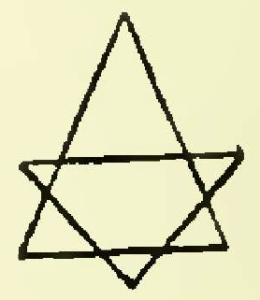
Druses Symbol
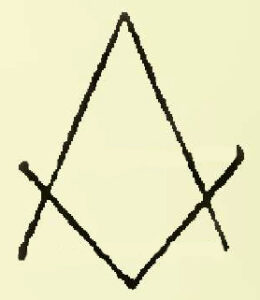
“Above this inscription is a rough emblem apparently intended for a double triangle. But I have noticed that the upper angle of the top triangle is always very acute, whilst the bottom angle of the lower triangle is invariably almost square. Take away the two horizontal lines, which may have erept in in the course of years, and we have the Masonic emblem of the Square and Compasses.“
Square & Compasses
“Above this device is an oval figure, undoubtedly intended to symbolize the Eye of God. Here then, again, we have distinct evidence of a close analogy between the emblematical designs of the Druse religion and those of the Craft of Freemasonry.“
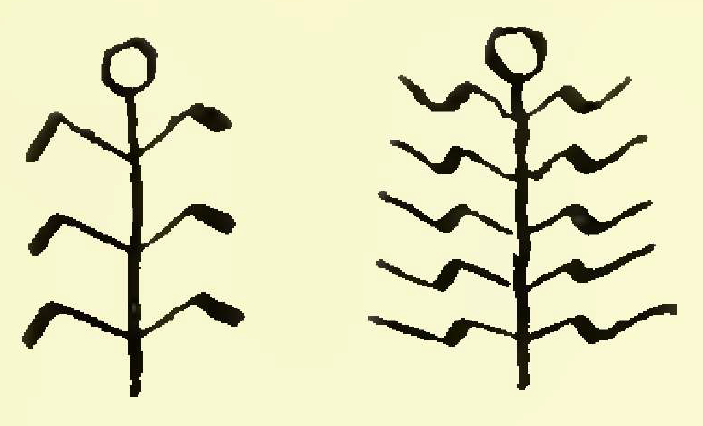
“Besides these are certain strange and forms which the Druse woman and girls called “Brides”, because, I presume, of their fancied resemblance to a human figure. They are, indeed, not so very unlike the first efforts of a child to draw the body of a man. But the peculiarity is that there are always an uneven number of arms and legs (or whatever they are meant to be) on each side.“
“Knowing the significance of the numbers 3 and 5 in Masonic symbolism, it has also seemed to me that here one has another evidence of the mystic relation between the two systems.“
“In connection with numbers, I may here point out that in the Druse esoteric code the number 7 occupies a very important place. Thus, according to them, the world has seen 7 great lawgivers, 7 special high priests, and 7 major prophets, each inspired by the 7 original spirits. The moral law of Hamzé is summend up under 7 heads, of the 3 principal of which I shall presently speak. But the most interesting, perhaps, of these combination of 7s, so fa as regards the relation of Drusedom to Freemasonry, is the belief which they hold as to the influence upon human affairs exerted by the ‘Seven Stars’. I have already intimated that the higher initiates into the mysteries of the Druses practice the secret arts of astrology. This divining from the stars is essentially confined to the motions and influences of what they call the Seven Planets. According to their belief the fixed stars have nothing to do with mundane affairs, and they have, therefore, entirely neglected the study of those constellations and orbs. Their attention is confined to the following: – Saturn, Jupiter, Mars, Venus, Mercury, the Sun and the Moon, and these are what they signify when they speak of the seven stars. These seven stars, they say, were specially created by the seven original spirits, under the directing sway of the One Great Architect of the Universe. Each of the seven is the special abode of a separate individual of these seven spirits, and from thence these seven spirits order and arrange all that happens in this world. […] Now, is it not possible that in this mystic astrological ‘superstition’ of the Druses we may trace some close connection with the seven stars of Masonic Lore?“
“I have said that the moral law of the Druse religion is contained in summery in seven articles, of which the first three may be regarded as the chief. What are these three?
(I) The Belief in One God and in His Eternal Truth. (II) The Exercise of Brotherly Love. (III) The Practice of Acts of Charity.“
“The Druses have been branded as non-religionists because they discountenance the practice of prayer. He further differs from the other great sects of Syria by his utter neglect of the practices of fasting and oblation. In the words of their lawgiver, ‘The true belief in the Truth of the One God shall take the place of Prayer; the exercise of Brotherly Love shall take the place of Fasting; and the practice of daily acts of Charity shall take the place of Almsgiving.’ Thus the practical religion upon which the Drusus conduct is to be regulated by the summed up in the well-known words: ‘Brotherly Love, Relief and Truth‘.“
“Even supposing that the origin of our sacred Craft is rightly to be traced to the ancestry of the Druses, it would be unreasonable to expect that at the prsent day we should find the two systems exactly identical upon all points of detail. We must remember that nearly 3000 years have elapsed since Hiram I, King of Tyre, sent his subjects to Jerusalem to assist in the building of King Solomon’s Temple.“
– Bro. Rev. Haskett Smith
Albert C. Mackey M.D. wrote in ‘Encyclopedia of Freemasonry and its Kindred Sciences’:
“There was between Freemasonry and the Crusades a much more intimate relation than has generally been supposed. In the first place, the communications frequently established by the Crusaders, and especially the Knights Templar, with the Saracens, led to the acquisition, by the former, of many of the dogmas of the secret societies of the East, such as the Essenes, the Assassins, and the Druses.“
Freemasonry, one of the oldest still existing fraternities, has a rich history and is still relevant today. It might look somewhat ‘mysterious’ at first glimpse, but it isn’t nearly as secretive and odd as some people and organisations might wish to make you believe. Even though a society with secrets, it’s not a secret society with hidden agendas, covert plans or surreptitious goals.
“Truth and authenticity must always, and in the first place, be sought; nothing must be accepted as historical which has not the internal and external evidences of historical verity, and in treating the legends of Masonry – of almost every one of which it may be said, “Se non vero, è ben trovato” – if it is not true, it is well invented – we are not to reject them as altogether fabulous, but as having some hidden and occult meaning, which, as in the case of all other symbols, we must diligently seek to discover. But if it be found that the legend has no symbolic significance, but is simply the distortion of a historical fact, we must carefully eliminate the fabulous increment, and leave the body of truth to which it had been added, to have its just value.” – Mackey, The History of Freemasonry
FREEMASONRY - WHAT DO FREEMASONS DO?
Introduction | Is Freemasonry a Mystery School? | What happens in the lodge ... | Introduction and development of Masonic Symbols | Masonic Rites | Masonic Lodge | Freemasonry &...
FREEMASONRY - WHAT'S IN A NAME ... ITS MEANING, ORIGIN AND HISTORY
The origin of Freemasonry as well as its name seem somewhat veiled in mystery. In this article I'll share some different theories on both her origin and history,...
The History of Freemasonry & Music
With music as one of the primary topics of writings on Roel's World, I had to share something about the relationship of Freemasonry with music. Music has been an integral part in Freemasonry from...
FREEMASONRY AND PROCLAIMED PREDECESSORS
In various books, movies and online sources, claims have been made about the origin of Freemasonry and presumed predecessors, such as the Knight Templar and Rosicrucian's. Let's shed some light...
Freemasonry - Colour Symbolism
I recommend you read my article 'Colour Symbolism ' first! It provides background information about what colour is and does, insightful thoughts by Carl Jung and Bro. Goethe, and some historical references,...
Freemasonry - 'Grand Architect of the Universe‘ (GAOTU)
Monotheism is considered the sole dogma of Freemasonry . Belief in a 'Supreme Being' is required of every initiate. Freemasonry is not concerned with theological distinctions t...
FREEMASONRY – WHAT’S IN A NAME … ITS MEANING, ORIGIN AND HISTORY
The origin of Freemasonry as well as its name seem somewhat veiled in mystery. In this article I’ll share some different theories on both her origin and history, as well as the meaning of ‘Free’ in Freemason(ry).
The word Freemasonry is a compound word, meaning 2 or more words being joined into one. In this case the words ‘free’ and ‘masonry. Masonry meaning ‘the art and craft of building and fabricating in stone, clay or brick’. The meaning of ‘Free‘ isn’t ‘written in stone’. There are various theories, often dependant on the historical interpretation of the origin of Freemasonry that varies as well. I will share a few interpretations in this article with you.
“The first mention of the English word freemason is in 1375, but we meet it in the Statutes of the Realm for the first time in 1459 (11 Hen. vin., c. xxii.), where the wages are fixed for a free mason, master carpenter and rough mason, respectively; evidently referring to different classes of workmen. There were many statutes where the distinction is made between freemason and ‘rough’ mason. ”
– Bro. G. W. Speth – Ars Quatuor Coronatorum vol. 10 (Quatuor Coronati Research Lodge)
The reference to ‘francs maçons’ (free masons) within the ‘Livre des Métiers’ is among the earliest mentions of the term in (French) historical documentation. In medieval times, continental Masons in France were gathered in a Franc-Mestier (Free-Craft), with special charges and rights; in 1315, King Louis X, “The Stubborn,” banned serfdom all over the French royal lands: so all his subjects became francs (free of serfdom) men, and masons among them thus Francs-Maçons.
There are two types of Free Masons: Operative Free Masons and Speculative (or Accepted) Freemasons.
OPERATIVE (FREE) MASONS
Operative (Free) Masons were craftsmen that primarily work with their hands (and tools), they actually build things.
When Operative Masonry started is hard to say. In the middle ages for example, Masons were involved in building cathedrals and castles, as in ancient Rome and Greece, where they were involved in building temples, palaces and coliseums, even in Egypt Masons were involved by the building of temples and pyramids … It’s questionable if that far back in time those Masons were actually Operative ‘Free Masons’. The way Masons organized, was through a guild, an association of artisans who oversee the practice of their craft in a particular territory. The earliest historical references to Masonry guilds date back to c. 2254–2218 BC in the Akkadian Empire (unified Sumeria and Assyria).
In the Cooke Manuscript there is a claim made about the first Masons: “Reason would that we should tell openly how, and in what manner, that the charges of mason-craft was first founded and who gave first the name of it of masonry. And ye shall know well that it [is] told and written in [the] Policronicon and in Methodius episcopus and Martyrus that Asure, that was a worthy lord of Sennare, sent to Nimrod the king, to send him masons and workmen of craft that might help him to make his city that he was in will to make.”
In Biblical chronology, Nimrod is placed in the generations after the Great Flood, as a descendant of Noah through Ham. This would roughly place him in the early post-Flood period, possibly around the time when ancient Mesopotamian civilizations like Sumer were forming, which is estimated to be in the late 4th millennium BCE to early 3rd millennium BCE. However, there is no direct archaeological evidence to pinpoint his exact reign or life.
It is important to note that throughout history not all Operative Masons were Operative Free Masons. With society becoming more complex and politically challenging, Operative (Free) Masons – often just skilled in their craft as stonemasons – figured it would be beneficial for their guilds if some members were educated in politics and science. Thus, distinguished men were admitted to their guilds, because of their political eminence, or their superiority as men of science. These new members passed through the rituals of the degrees, and were called Accepted Masons. These guilds thus became known as guilds of ‘Free and Accepted Masons’. Even when in time they became fully Speculative, they kept identifying themselves as “Free and Accepted.”
‘Free‘ in Freemason might suggest ‘a mason without a long-term commitment to any one employer’. This interpretation of ‘free’ applies primarily for Operative Free Masons. Free Masonry would thus be the craft of building and fabricating in stone, clay or brick without a long-term commitment to any one employer.
ANOTHER POINT OF VIEW If it were that Freemason simply meant a mason free of a long-term commitment with any employer, company or gild of masons, if this were so, we should expect to see other craftsmen and gilds – besides those of the masons – adopting this working method. That though only happened occasionally.
In the essay “Free and Freemasonry: A Tentative Equiry” (published in Ars Quatuor Coronatorum vol. 10 of the Quatuor Coronati Research Lodge) Bro. G. W. Speth mentioned:
“It is a self-evident proposition that masons existed in goodly numbers long before any city gild of masons was formed ; and I think it may fairly be sustained that large numbers of highly-skilled masons must have been scattered up and down the country. ”
“The whole land was being covered with the most exquisite specimens of Norman and Gothic architecture, in the shape of Abbeys, Cathedrals, Monasteries, Castles, Chapels, etc., in cities, towns and the countryside alike. Masons of the highest skill existed, therefore, in great numbers, and these I will for the moment designate as ‘church-building masons’. ”
“A church-building mason, travelling mason, was immediately recognised and treated as a fellow, a co-member of the fraternity. The Old Charges enjoin that he shall be given employment, or failing that, helped to the next Lodge. Herein they differed from the city gilds of masons established later, who like all other craft gilds in towns, were strictly localised. Each citygild was an entity in itself, and recognised none as entitled to work within its jurisdiction except those who had served an apprenticeship to one of its freemen, or otherwise acquired its freedom. But the church-builders all belonged to one fraternity, and found work wherever church buildings were in course of erection.”
“A gild member in a city could always point to his indentures entered in his Company’s books, and to his freedom entered at the Guildhall. A church-builder could not do that. If his indenture existed in writing which is doubtful, it might be miles away, he must therefore have means to establish not only that he was at one time an apprentice to the craft, but also that he had served his full time, and had been passed a master of the craft. This he was enabled to do by secret grips, tokens, signs.”
“Some of the church-builders might join the gild, others would be contented to go on in the old way. Two events would inevitably occur. First, the city-gild would endeavour to force thechurch-builders into their own ranks, to compel them to take up the freedom of the city,and failing this they would attempt to prevent them exercising their craft. Secondly, theywould complain of their admitting foreigners, i.e., travelling masons coming from elsewhere,to work within the city and its liberties. The church-masons would reply that these wereold customs, that their own laws obliged them to find work for strangers coming over thecountry, and that, though within the city walls, they were not under the jurisdiction of thecity authorities, inasmuch as they were working on church soil, which was extra municipal.”
Writer John R. Bennett shares the following view on the history:
“In the year 716 A. D. the English monk, St. Boniface, went into Germany and organized a special class of monks for the practice of building, under the name of Operarii, or Craftsmen, and Magestri Operum, or Masters of the Works. Some of them designed the plan of the building, others were painters and sculptors, and then there were those who were called ‘coementarii’, or stonemasons, who performed the practical labors of construction. Then, by degrees, the knowledge of the arts and sciences went from these monkish builders out into the world, and the laymen architects, withdrawing from the ecclesiastical fraternities, organized brotherhoods of their own. These independent brotherhoods now began to be called upon wherever an important building was to be erected, and eventually they entirely superseded the monkish teachers in the prosecution of the art of building. But now a new classification took place. The more intelligent of the laymen, who had received these secrets from the monks, were distinguished as architects from the ordinary laborers, or common masons. These brotherhoods of high artists soon won great esteem, and many privileges and franchises were conceded to them by the municipal authorities among whom they practiced their profession. Their places of assembly were called Lodges, and the members took the name of Free masons. Their patron saint was St . John the Baptist, who was honored by them as the mediator between the old and the new covenants, and the frirst martyr of the Christian religion. Such was the beginning of the brotherhoods of (free)Masons in Germany.”
“In the beginning of the tenth century a Fraternity of Architects was founded in France, and was similar to that of their German brethren. Originating like them, from the cloisters, and from the employment of laymen by the monkish architects, the connection between the Masons of France and the Roman Colleges of Artificers was more intimate and direct than that of the Germans. The principal seat of the French Fraternity was at Como, a city of Lombardy, from where the Lodges were disseminated over the kingdom, and who passed from country to country and from city to city under the name of “Traveling Freemasons.”
ACCEPTED (OR SPECULATIVE) FREEMASONS
Accepted (or Speculative) Freemasons were educated men, scholars. One of the differences with Operative Free Masons is that they do not apply ‘the craft’ for an employer, they symbolically apply ‘the craft’ for themselves (personal development) and their fellow Brethren, not by written contract but by vows put to words during their initiation and follow-up rituals while climbing the ladder of degrees. Generally speaking when we use the term Freemason/Freemasonry (compound word), we nowadays mean a Speculative Freemason and Speculative Freemasonry.
The origin of Speculative Freemasonry is also not easy to pinpoint. The oldest and most important Masonic manuscripts that suggests the existence of (Speculative) Freemasonry are: The Regius Manuscript (1390), The Cooke Manuscript (1450), The Schaw Statutes (1598-1599), Inigo James Manuscript – (1655, Regular Grand Lodge of England) and the in Freemasonry commonly known ‘Constitutions’ (Londen, 1723) by Rev. James Anderson. These are a few of the most important manuscripts, statues and constitutions that together with several other (33 in total) are known as the ‘Old Charges‘.
What is fact, is that the first Masonic Grand Lodge was established in England in 1717 as the Grand Lodge of London and Westminster, soon to call itself the Grand Lodge of England. Before the establishment of a Grand Lodge, independent Lodges did already exist though. What Lodge was first seems still a matter of some debate. What I being said is the following:
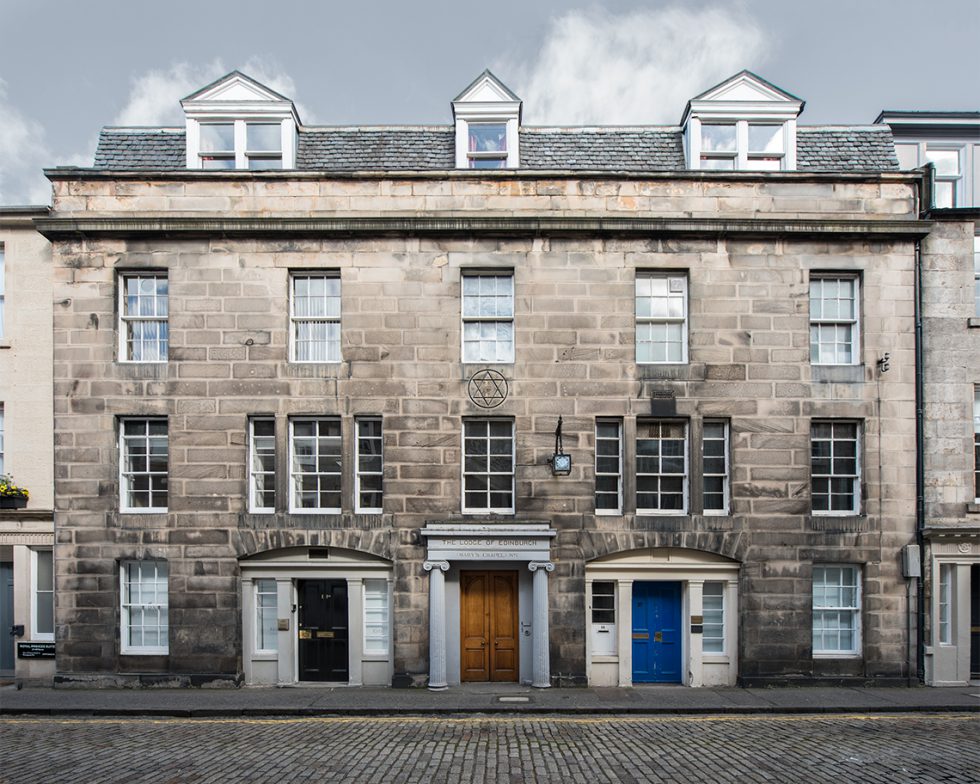
“The oldest written records for a Masonic lodge belong to Aitchison’s Haven Lodge, Muddelburgh, UK. They date back to 9 Jan 1599. The oldest written records for a Masonic lodge that is still in existence today are from The Lodge of Edinburgh (Mary’s Chapel), No 1, Uk. They date back to 31 July 1599.“. Most impressively, its first 5 pages incorporate the Schaw Statutes which are dated December 28, 1598.
The Lodge of Edinburgh
Freemasonry is not a single global fraternity, there are many different Orders (Masonic Bodies). In this article I only wrote about the so called “Blue Lodge” or ‘Symbolic Lodge” degrees in Masonry (1-3: Entered Apprentice, Fellow Craft and Master Mason). Originally only Lodges for men were founded. At present day male Freemasonry Orders and Lodges are still the “the lion’s share” within Freemasonry. In 1893 ‘The International Order of Freemasonry Le Droit Humain‘ was founded, membership of which is available to men and women (on equal terms). ‘The Order of Women Freemasons‘ (founded in 1958) is an example of the various female only Orders that appeared.
You can read more about Lodges, their Rites, Symbolism, activities, et cetera in “What do Freemasons do?” (on Roel’s World).
Supposition: ‘Free’ in Freemason might suggest free as in ‘freethinking’ and ‘free will’. A Freethinker holds that beliefs should not be formed on the basis of authority, tradition, revelation, or dogma, and should instead be reached by other methods such as logic, reason, and empirical observation.
ANOTHER POINT OF VIEW
In “Free and Freemason“, an essay by German Bro. F. F. Schnitger (written for and published in 1889 in ‘Ars Quatuor Coronatorum vol. 2’ (Research Lodge Quatuor Coronati, London), Bro. Schnitger researched the meaning of ‘Free’ in connection with Free Mason’.
Bro. Schnitger writes: “Free is evidently of Saxon origin, and it may therefore be permissible to enquire what meaning was in olden time attached to the corresponding ‘frey‘ and ‘frei‘.”
In this essay he also shared several quotes from Mathematician Gualtherus H. Rivius who said in his report on the ‘Mathematical and Mechanical Arts of Architecture’ (1558): “Therefor did the ancients hold this art (painting) in such high honour and respect, that they did except the painter’s art from all other handicrafts, and did not call it ‘fabrilem’[1] but ‘pictūram’[2], and considered it a free art (Freye Kunst) and not handicraft (Handtwerck).”
[1] From Latin fabrilis, from faber (“workman”), relating to stonework, metalwork, woodwork, etc. [2] from Latin pictūra (“a painting”), from pictum + -tūra, from the supine of pingō (“I paint”).
On the subject of Sculpture Rivius also shared: “Sculpture – under which denomination we do not only understand the art of the ‘picture hewer’ and ‘picture carver’, but all such like artistic work of forming in all kinds of material – is indeed an excellent art and amongst all ‘artistic handiwork’ the ‘most free’ and particularly fit for a ‘noble’ mind, and has always been properly appreciated at such value by all sensible people, that is could never be separated or disconnected from other ‘free’ mathematical arts. The learned translator and composer of this important work on architecture and the other “free” mathematical arts recommends its use on the title page to all artistic handicraftsmen, work masters, stonemasons, master builders, cannon and rifle masters, painters, carvers, goldsmiths, and whosoever uses Compasses and Squire artistically.”
Bro. Schnitger then proceeded with: “From the foregoing I feel justified in claiming that a Free Mason or Free Stone Mason was no more a man working in freestone then he was “free to be a mason;” he was not a handicraftsman, but an “artisan mason” instructed in the “free mathematical arts”. In other words, he was a man who understood the theoretical and mathematical doctrine of his craft, which need not exclude his own serving a practical apprenticeship.“
Supposition: Could ‘Free’ in Speculative Freemasonry also be interpreted as a reference of being educated in the Artes Liberales? The Fellowcraft Degree commends Freemasons to study the 7 Liberal Arts and Sciences, often visualised as the final 7 steps of the ‘Winding Stairs’.
Line of thought: “freemathematicalarts“ and Freye Kunst → ‘Artes Liberales‘ (Liberales = Latin for free). Arithmetic and Geometry → the mathematical Liberal (free) arts.
SO … WHAT’S IN THAT NAME?
There you have it, sweet and all … several possible interpretations about what ‘Free’ might have meant in resume:
A mason without a long-term commitment to any one employer.
A mason who did not fall under the jurisdiction of city authorities and/or free from guild regulations.
A mason who has/had been instructed in the Liberal Arts (liberales = free).
A mason who is/was a Freethinker
A mason who was a man free of serfdom (francs maçon)
A reference to a different class of craftsmen (rough mason vs free mason)
Does one interpretation smell sweeter then the others?
I couldn’t tell you for certain, like many Brethren before me. And perhaps some mysteries should not be unveiled entirely but left to the imagination. For a society (with secrets), where symbolism and allegories play such a fundamental role, and so rich is of traditions, it probably should not matter.
It was though fun to speculate about Speculative Freemasonry!
‘A peculiar system of morality veiled in allegories and illustrated by Symbols’
A peculiar system of … say what?
Albert G. Mackey explains it as follows: “Freemasonry is a science — a philosophy — a system of doctrines which is taught, in a manner peculiar to itself, by allegories and symbols. This is its internal character. Its ceremonies are external additions, which affect not its substance.“
So, what do Freemasons do? Freemasons gather regularly to perform rituals and ceremonies. These rituals and ceremonies contain (a) narrative(s) that conveys a meaning not explicitly set forth in the narrative. They describe situations and events or express ideas by means of symbolic events, figures and / or their actions.
Besides performing rituals and ceremonies, there is another (even more?) important aspect to Freemasonry. That is one of self-improvement, or as sometimes mentioned: “Making good men better”. Not better then someone else, but a better version of oneself. Besides improving oneself, a Freemason also likes to play a role in improving the world. Charity, the voluntary giving of help, is one of the values of Freemasonry. Some prefer donating money, others prefer helping through ‘sweat, determination and hard work ’.
Throughout history, Freemasonry has profoundly influenced the construction of civil society by promoting principles of democratic coexistence and ethical values with its emphasis on reason, places mutual respect and the search for truth at the core of its philosophy.
Monotheism is considered the sole dogma of Freemasonry though. Belief in a ‘Supreme Being’ is required of every initiate, Freemasonry is not concerned though with theological distinctions, the conception of the ‘Supreme Being’ is left to the Freemason’s own interpretation. [ Read more about this on Roel’s World ]
Even though in theory any man above a certain age (differs from Lodge to Lodge) is welcome to join, it doesn’t mean one can just ‘walk in’ and participate. Most Lodges (buildings or chapters of Freemasons) will first have lengthy conversations with a candidate and once convinced the membership will benefit both the candidate and Lodge, an initiation ritual is held. This means Freemasonry is an exclusive ‘members only’ Brotherhood.
IS FREEMASONRY A MODERN MYSTERY SCHOOL?
The word ‘school’ is derived from the Greek ‘σχολή’, which means ‘free time’. Education was something for which one had to have free time. Freemasons ‘labour’ at the Lodge in their free time, the time that remains after they have fulfilled all their worldly obligations in the mundane world.
In Ancient Greece, there were no public schools; only wealthy children received education from private tutors. THE ‘school’ in Athens was Plato’s Akademeia. In this ‘school’, however, there were no classes or examinations. It was a place where wealthy thinkers conversed with each other, sharing viewpoints, with Plato’s ideas as a starting point. Aristotle’s Lyceum was similar, where Aristotle gave a lecture – what Freemasons call ‘symbolic lectures’ or ‘lectures of ‘the craft’, in the Netherlands (literally translated) are called ‘building pieces’ – twice a day.
The primary function of a mystery school is to preserve, perpetuate, and protect the ancient systems of enlightenment, manifestation, and transformation so that they can be practiced and shared today and for thousands of years to come.
These ancient brotherhoods (and sisterhoods) served “The Light” by offering teachings, performing rituals and ceremonies, and training the neophytes who will keep the ancient knowledge alive and accessible. Some mystery schools were initiatory (thus only for people that took the rite of passage, marking entrance or acceptance into a group or society), like with Pythagoras’ school (with a five-year initiation period of listening in silence). While evidence of these traditions and teachings can be found throughout history, the lineage of the mystery schools can be traced back at least 3,000+ years to the time of King Solomon, an important figure in Freemasonry. To me the description given above matches the essence of Freemasonry: an initiatory Brotherhood, performing rituals and ceremonies, preserving and protecting it’s traditions and teachings, with Brethren whom seek “The Light”.
In The Netherlands Brethren gather as well at the Lodge to listen to ‘lectures’ and small essays, in order to converse and share thoughts about it afterwards. These gatherings are called “Comparitie” (Dutch), meaning: an appearance to exchange knowledge, insights and experiences with one another in line with that lecture/essay. It’s not a debate or discussion, no judgements and no intent to convince others about one’s own views. It’s more like a ‘think tank’ where different ideas about the same topic are put together in order to broaden the horizon. Topics often relate to Freemasonry and it’s goals, as well as various spiritual and esoteric topics (such as Gnosis, Hermeticism, Kabbalah, Spiritual Alchemy, and more such topics, but may also be a very personal life story). To me those ‘Comparities’ resemble Plato’s Akademeia and Aristotle’s Lyceum.
‘WHAT EVER HAPPENS IN THE LOGDE, STAYS IN THE LODGE’
There is a good reason for some secrecy about what takes place at the Lodge. First of all the Brethren should be free to speak their minds, without being judged, no matter how extreme it might seem. The practically unlimited freedom to speak one’s mind, comes also with a huge responsibility to use that freedom wisely. Unethical behaviour like discrimination and racism are not tolerated, nor disrespectful behaviour towards other Brethren. Morals and ethics are fundamental in Freemasonry. And due to the intend to be dogma-free, it resembles ‘Freethought’. Naturally it might differ from country, Order or Lodge in what way this pans out. And because everything stays behind closed doors, the Brethren don’t have to worry something they say could ‘bite them in the ass’ in their regular, mundane (non-masonic) part of life.
There is yet another reason for secrecy. The rituals and ceremonies held in the Temple of Masonic Lodge are illustrated with many symbols and are veiled in allegory. This makes it for the non-mason – who hasn’t been educated in symbolism and the backgrounds of Freemasonry – difficult to interpret. Misunderstanding often lead to misinformation, disinformation and conspiracy theories. And there is a good reason for Freemasons to lack trust about the leadership in the mundane world. Throughout history there have been various attempts made to discredit or even ban Freemasonry (see Anti-Masonry), most speaking to the imagination were the Papal ban of 1738 until 1983, declared in Vatican City, Rome … and the ban by Hitler during WWII ( interesting story and symbolism: ❀ ). Fortunately nowadays in most countries one is free to be a Freemason. In some countries like the USA and UK, Freemasonry has become a (public) lifestyle one can be open and proud about.
Even though secret words, tokens and grips are used to make sure only members may enter, it doesn’t mean that Freemasonry is a “secret organisation” or “secret society”. It is, though, a society with secrets. Some things do stay behind closed doors, but ‘keeping secrets’ isn’t questionable per say. In fact, it’s common practice in society with many organisations. The members of a football team, for example, keep their game tactics secret before a match. A business strategy discussed among board members doesn’t leave the office. The military won’t share their troop deployments with the public, nor does the police before executing a raid. Lawyers are upholding the attorney-client privilege and we can all agree that it’s a blessing doctors and psychologist keep your secrets secret. There is nothing wrong with secrets if one’s intentions are sincere.
Andaz London Liverpool Street
INTRODUCTION AND DEVELOPMENT OF MASONIC SYMBOLISM
The introduction of symbolism in Freemasonry was a gradual development that evolved over centuries. Early stonemason guilds used symbols related to their trade (like the square and compasses and other tools required for their labour) for practical purposes.
Over time, the symbols acquired more philosophical and moral meanings. Beginning in the late 16th and early 17th centuries, Masonic symbols were increasingly imbued with allegorical and moral meanings. However, the key period for the formal incorporation of Masonic symbolism, particularly through allegories and rituals, began with the formation of the Grand Lodge of England in 1717. James Anderson, a minister and Freemason, played a significant role in shaping early Masonic symbolism. He wrote the “Constitutions of the Freemasons” (published in 1723), which outlined Masonic history, principles, and the symbolic structure of Freemasonry. William Preston, an 18th-century Freemason, is known for his work “Illustrations of Masonry” (first published in 1772), which systematized Masonic rituals and elaborated on the symbolism used within the Craft. In the 19th century, Albert Pike, a prominent Freemason, expanded on the symbolic teachings of Freemasonry in his work “Morals and Dogma of the Ancient and Accepted Scottish Rite of Freemasonry“. He provided extensive interpretations of Masonic symbols and their philosophical underpinnings.
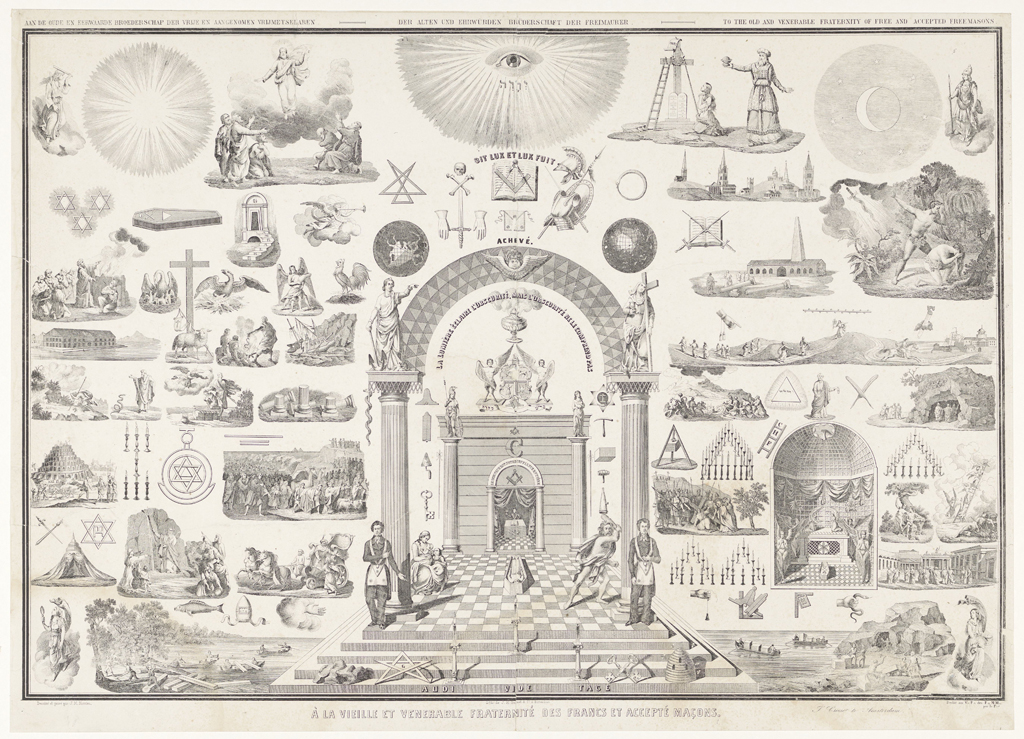
Besides the symbolism taken from Operative Masonry, also ‘Light Symbolism’ is used in and Blue Loge Rituals. A Freemason is symbolically a ‘Light Seeker’ (seeking truth, knowledge, wisdom, enlightenment). In the rituals are many symbolic references to light and darkness and many symbols used to emphasize it’s importance.
“So important , indeed, is it (Light), and so much does it pervade with its influence the whole Masonic system, that Freemasonry itself anciently received, among other appellations, that of Lux, or Light, to signify that it is to be regarded as that sublime doctrine of Divine Truth by which the path of him who has attained it is to be illuminated in his pilgrimage of life.” – Albert Mackey
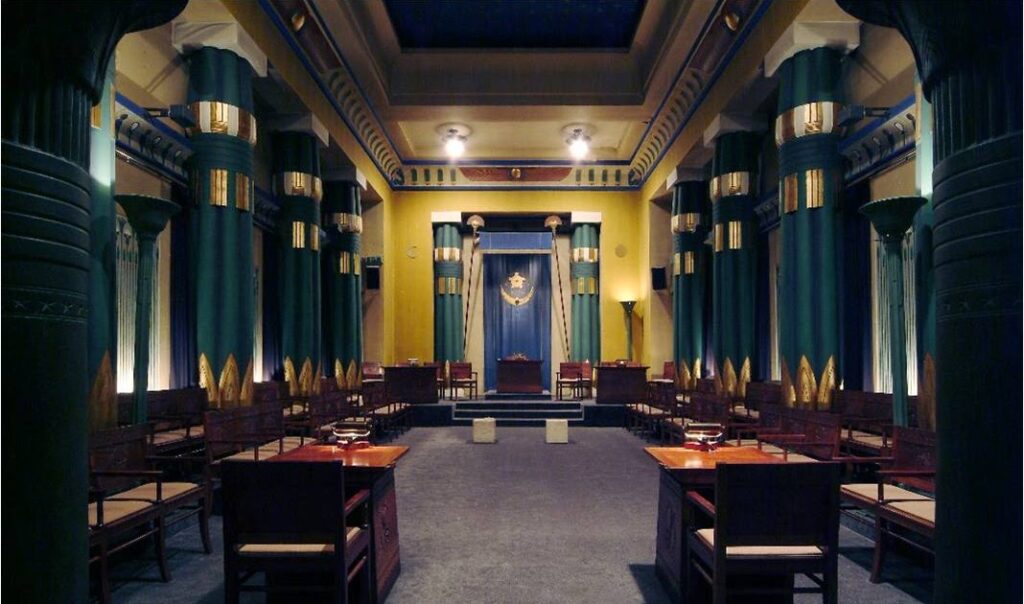
Some Lodges use additional symbolism, for example from Alchemy. In Rituals from another Orders also symbolism from Ancient Egypt play a role, like in the Ancient and Primitive Rite of Memphis-Misraïm. That Rite has no connection with the Blue Lodge Rites, thus is for this article of no further importance.
Natiehuis La Flandre met vrijmetselaarstempel – Brugge
MASONIC RITE
As mentioned earlier, Rituals are core to Freemasonry, performed in Masonic Temples by the Brethren of the Lodge. Even though most Rituals can be found online or are described in books, I will not share their content in this article. Yes, that bit of ‘secrecy’ I took an oath to ‘what happens in the lodge …’
Not every Lodge uses the same Rites, that depends on the Order and/or Lodge itself. In time Rites changed as well. The most common Rites used in a “Blue Lodge” or ‘Symbolic Lodge” (first 3 degrees of Freemasonry) are:
◾French Rite (Rite Français, a.k.a. “the ritual”) / “Modern French Rite“
◾Swedish Rite (In Scandinavia and the Nordic states)
MASONIC LODGE / CENTER / HALL
Freemasons gather regularly in a building called ‘Masonic Hall’, ‘Masonic Center’ or most commonly ‘Masonic Lodge’ to perform rituals and ceremonies.
“The term ‘Lodge’ is met with so early as the fourteenth century, and actual records of lodge assemblies in Great Britain are still preserved, dating from the year 1599, the succeeding century being especially rich in minutes descriptive of the initiation of ‘Geomatic’, or non-operative members, many of them were prominent and distinguished personages of that period.” (source: Masonic Records 1717-1894 – Second Edition – John Lane, F.C.A,)
In some countries the word ‘Lodge’ is also used to refer to a local ‘chapter’ (a local division) of Freemasons. A Lodge is thus both a building as well as a chapter. In the beginnings of Freemasonry Lodges (chapters) did not own a building (Masonic Lodge) to gather at. The Lodge (chapter) would meet regularly somewhere in town, but often at the local pub (when closed for it’s customers).
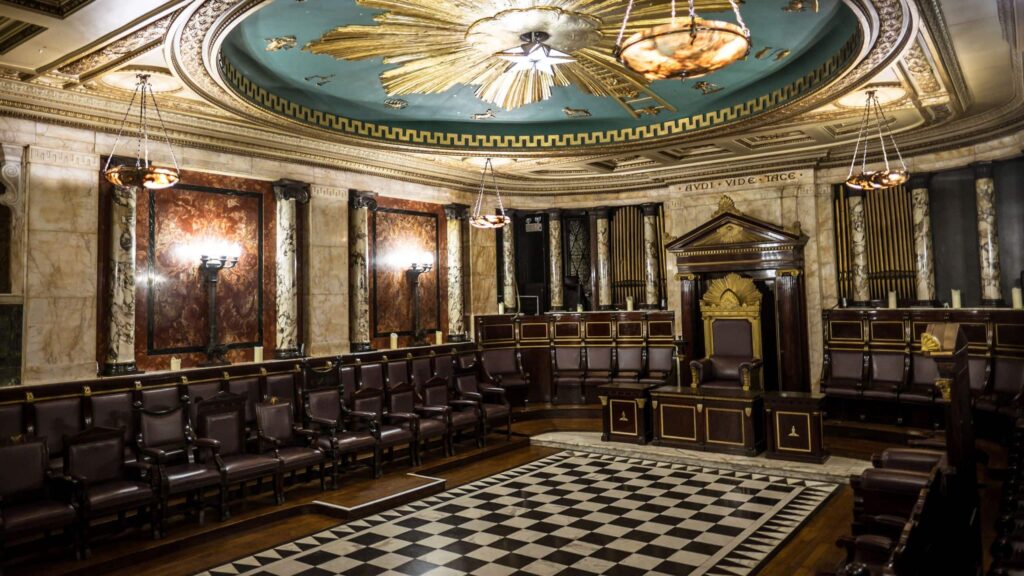
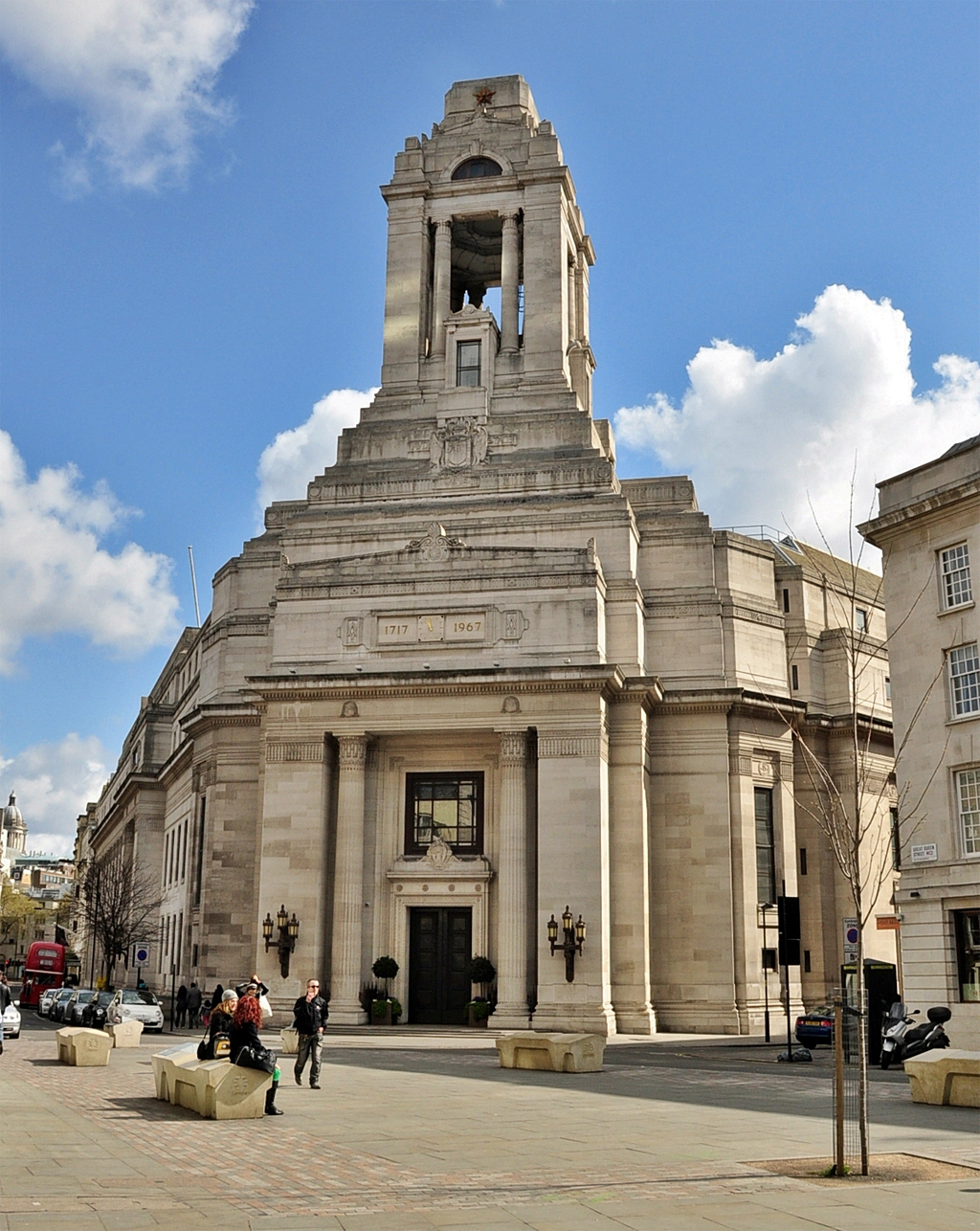
Freemasons Hall London
Depending on the Masonic Lodge (building), various facilities are housed.
The most important room is the ‘Temple’ where rituals and ceremonies are performed. A Temple is a place of worship as well as a building used for spiritual rituals and activities.
Even though the term ‘Temple’ might sound very ‘Christian’ or religious to you, Freemasonry is not a religion, nor a cult. Monotheism though, is considered the sole dogma of Freemasonry. This might sound contradictory to what I just wrote about Freemasonry not being a religion. Belief in a ‘Supreme Being’ is required of every initiate, it is an important distinction that separates Freemasonry from purely secular or philosophical organizations. Freemasonry is not concerned with theological distinctions though, thus the conception of the ‘Supreme Being’ is left to the Freemason’s own interpretation. In some countries, Orders and Lodges religion plays a lesser role, or hardly any role, except for the allegories and symbols used during rituals, ceremonies and the Masonic Method, or ‘Masonic Instruction’ (education). In Anglo-Saxons countries, Lodges lean a bit more towards Christianity, but Lodges are (under certain conditions) open for anyone to join (to be initiated), no matter your faith and what kind of ‘Supreme Being’ you believe in …
Being a Pantheist myself, you could imagine the concept of a ‘Supreme Being’ seemed hard to match with the lack of a separate or independent Deity in Pantheism (←article on Roel’s World). It is though less complicated then it appears, as I describe in ‘Freemasonry – ‘Grand Architect of the Universe‘ (GAOTU)‘ on Roel’s World.
LIKED WHAT YOU READ?
Has this article made you wonder if Freemasonry is something for you?
Be aware that rituals and ceremonies are essential, it’s Rituals is what differentiates Freemasonry from other Fraternities or Brotherhoods. If rituals, ceremonies, symbolism and allegories ‘ain’t your thing’, then Freemasonry isn’t for you. On the other hand if it is what you’re looking for, then making contact with a local Lodge is the way to go!
And last but not least I’d like to make a suggestion:
Don’t go digging online (except for information how to join of course). Most rituals can be found online if you dig deep enough. And there are many articles and Youtube videos that ‘expose what goes on in a Lodge’. Some of these are misleading or even odd conspiracy-like, others do actually tell you for example what’s going to happen when you are initiated. I suggest not reading and watching any of that. Some things you should not read but simply experience first, to make it a memorable and perhaps life-changing experience. Once you’re initiated I am pretty sure your Brethren will tell you what books and articles are worth watching. And no worries, nothing unlawful is allowed to happen in a Lodge, unlike what some silly conspiracy stories might suggest, it’s no cult, nor a criminal organisation. You enter the Lodge by free will and are always free to leave, if turns out Freemasonry ain’t for you.